- Details
-
 By Agora Policy
 - Blog
- Hits: 1147
By Ayobami Ayorinde, Maryam Ibrahim and Oluchi Nkeonye | Around the middle of July, the Federation Account Allocation Committee (FAAC) shared the revenue generated for the month of June 2026 among the three tiers of government and other statutory recipients. This allocation marks the end of the first half of the 2026 fiscal year, providing an opportunity to examine how FAAC disbursements have evolved over the past six months. In this analysis, we review allocation trends from January to June of 2026 and highlight the implications for fiscal management across the three tiers of government.
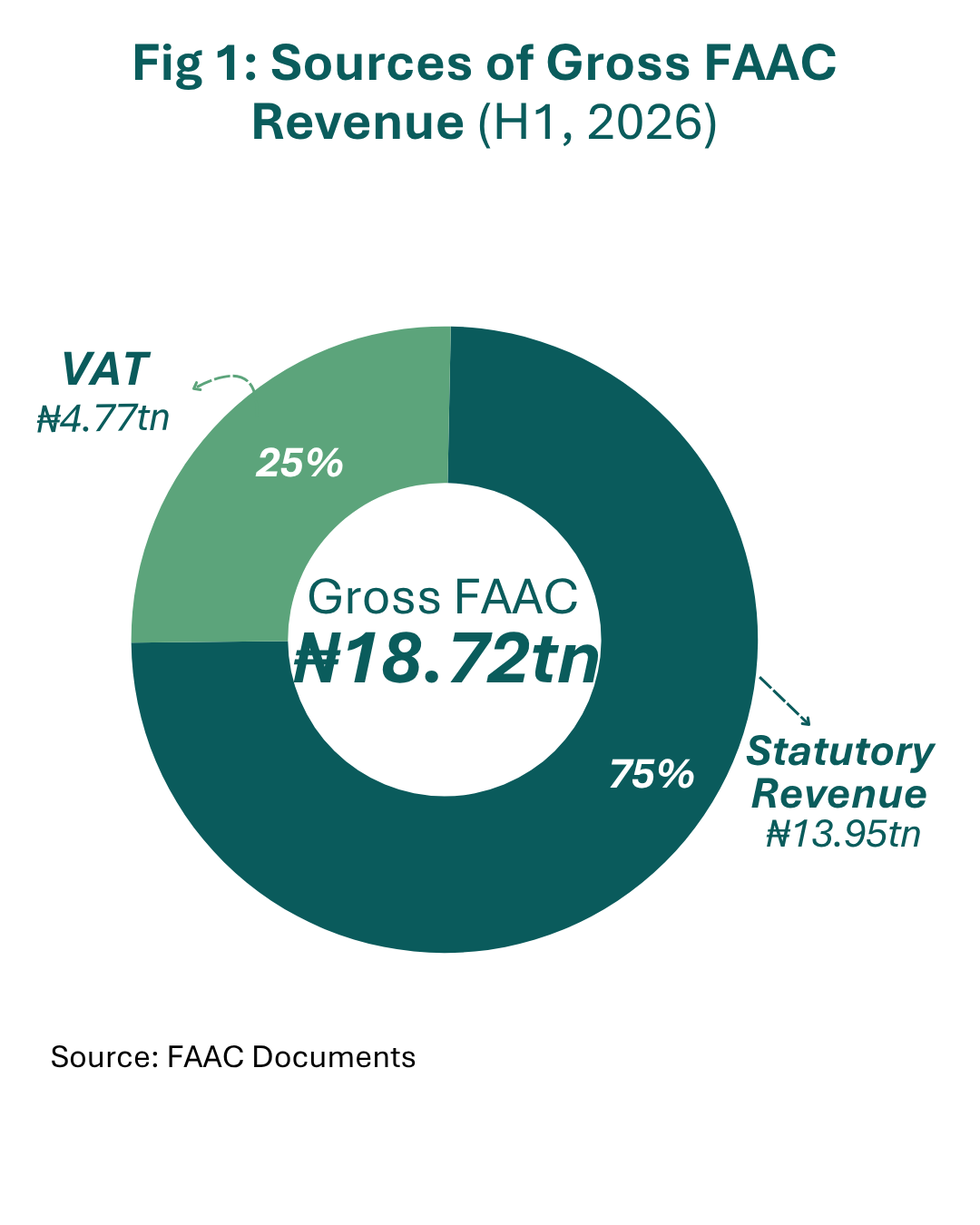
The total gross FAAC revenue in the first half of 2026 was ₦18.72 trillion. Statutory revenue remained the dominant source of FAAC receipts, contributing ₦13.95 trillion, which is equivalent to 75% of the total gross revenue, while VAT accounted for ₦4.77 trillion (25%) as shown in Fig 1.
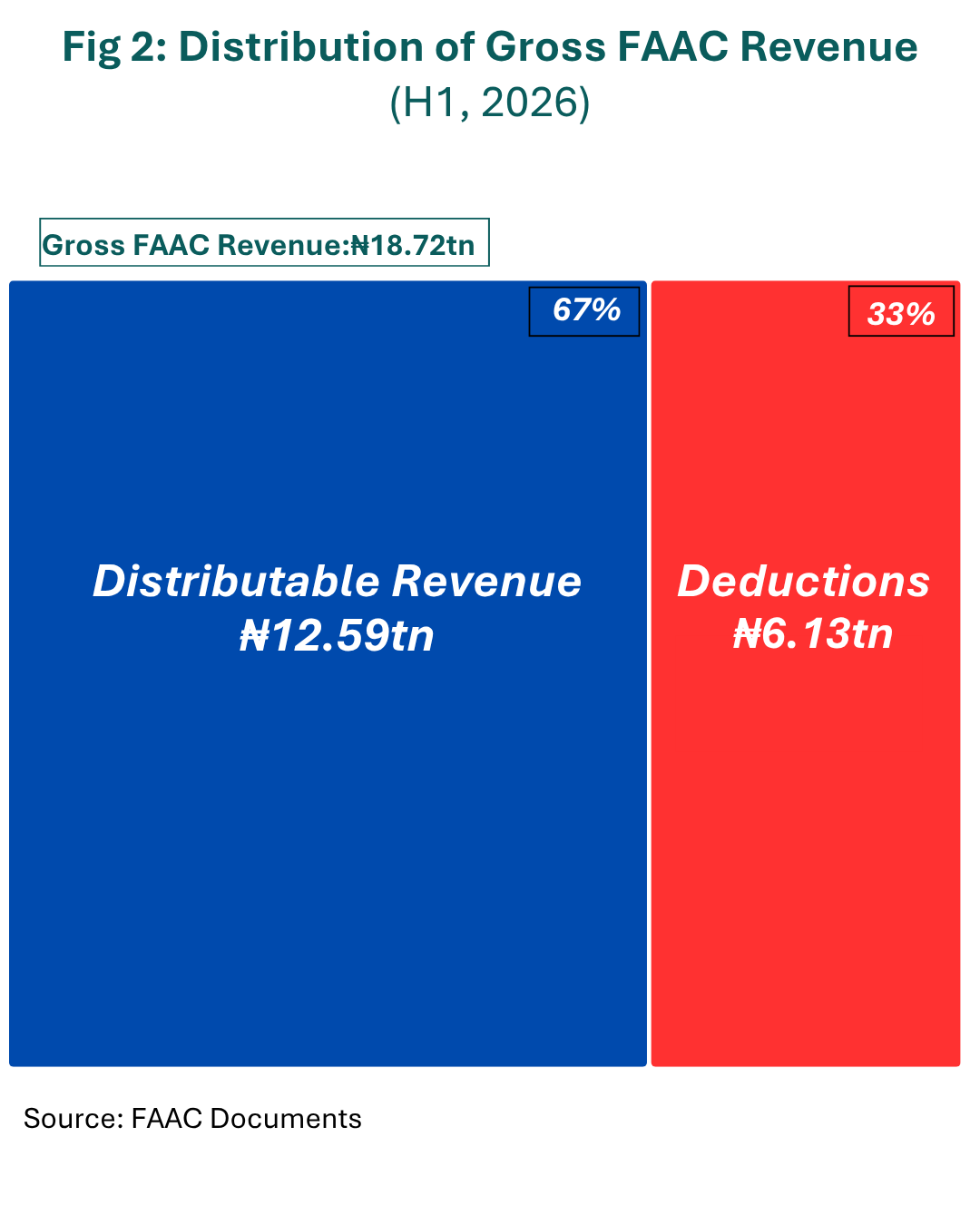
Of the total gross revenue generated during the period, ₦12.59 trillion (67%) was available for distribution to the three tiers of government, while the remaining ₦6.13 trillion (33%) was deducted for savings, interventions, refunds, transfers, and the cost of collection, as seen in Fig 2.
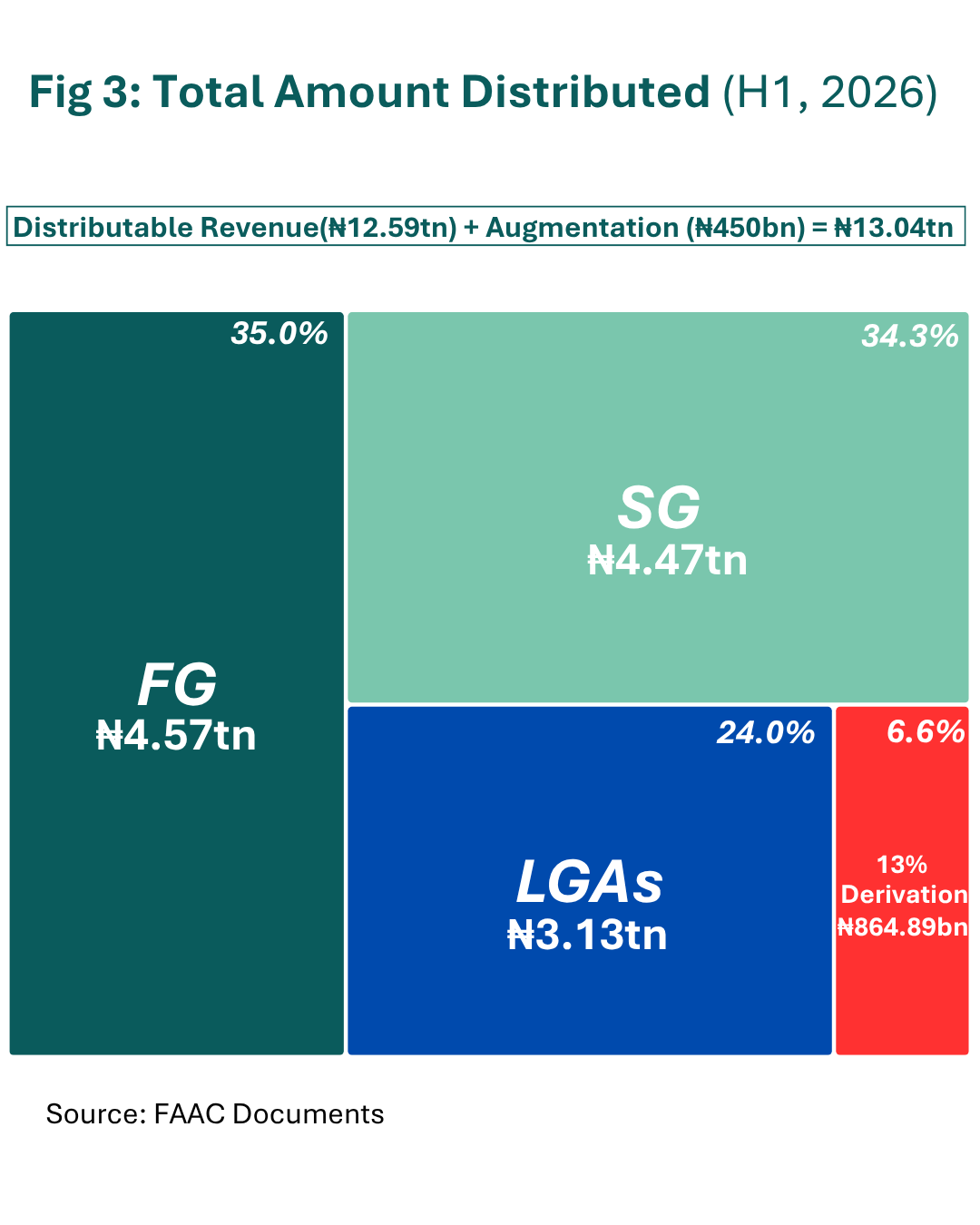
The total distributable revenue and augmentation for the first half of 2026 was shared across the three tiers of government. The Federal Government received ₦4.57 trillion while the 36 states shared ₦4.47 trillion. The 774 Local Government Areas received ₦3.13 trillion while the 13% derivation allocation to oil-producing states amounted to ₦864.89 billion, as shown in Fig 3.
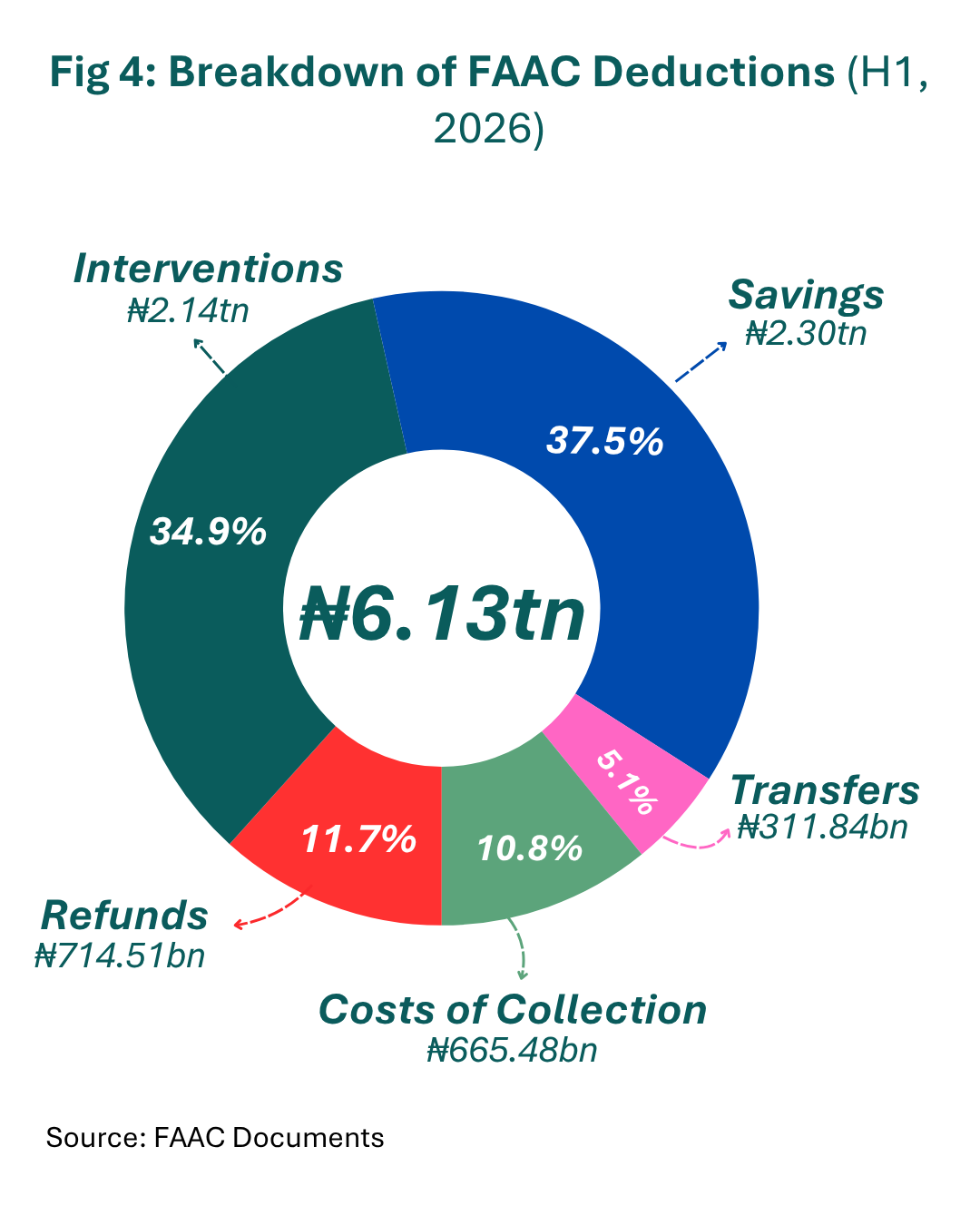
An analysis of the deductions shows that Savings and Interventions accounted for the largest share, amounting to ₦2.30 trillion and ₦2.14 trillion, respectively. These two represented the bulk of all deductions made during the period. Refunds followed at ₦714.51 billion while the Cost of Collection stood at ₦665.48 billion. Transfers, at ₦311.84 billion, were the smallest deduction in the first half of the year, as shown in Fig 4.
Below are some insights from FAAC Disbursements in the first half of 2026.
Half-Year Gross FAAC Revenue Increased by over 300% in Six Years
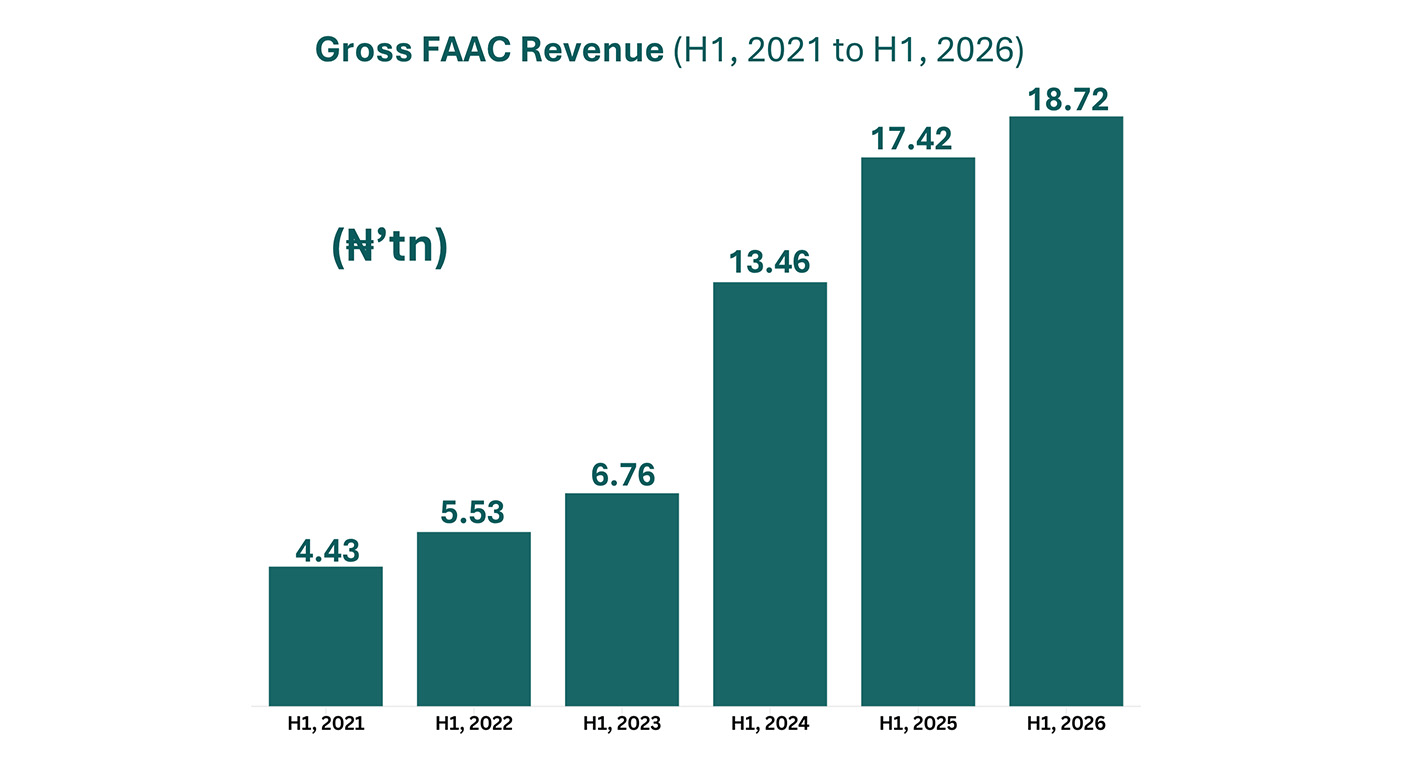
Between the first half of 2021 and the first half of 2026, gross FAAC revenue increased significantly by 323% from ₦4.43 trillion to ₦18.72 trillion as seen in Fig 5. More interesting is that the ₦18.72 trillion generated in just the first six months of 2026 exceeded the entire gross FAAC revenue recorded in each of 2021, 2022, and 2023 in nominal terms as shown in Fig 6.

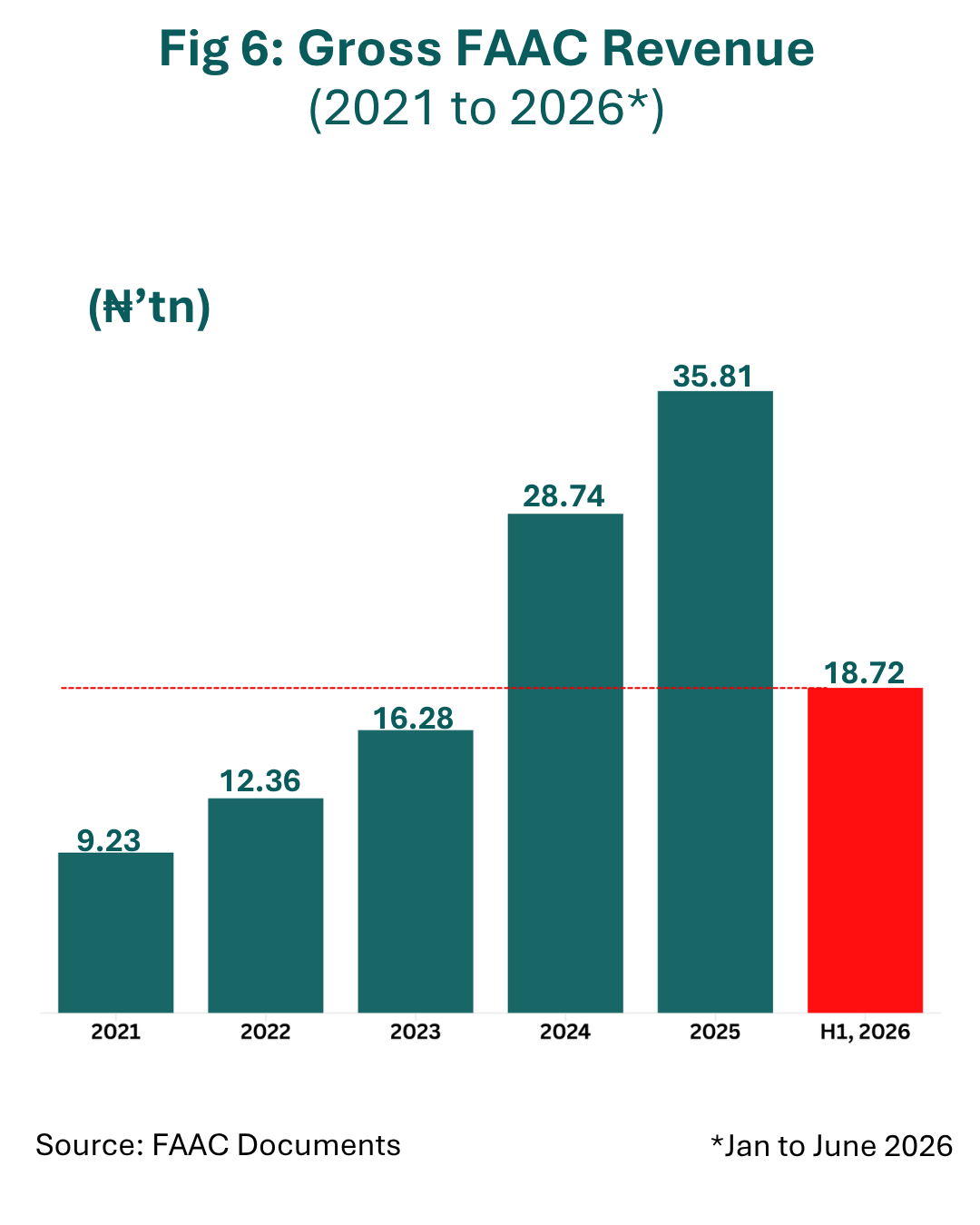
The ₦18.72 trillion generated between January and June 2026 represents 52% of the ₦35.81 trillion gross FAAC revenue recorded for the whole of 2025. If this trend of revenue performance continues in the second half of the year, the gross FAAC revenue for 2026 may exceed that of 2025.
Increase in Distributable Revenue, Decrease in Deductions
Distributable revenue in the first half of 2026 rose by 24.4% from ₦10.12 trillion in H1 2025 to ₦12.59 trillion in H1 2026 as seen in Fig. 7 below. Over the same period, FAAC deductions declined by 16%, falling from ₦7.30 trillion in the first half of 2025 to ₦6.13 trillion in the corresponding period of 2026 as shown in Fig. 8.

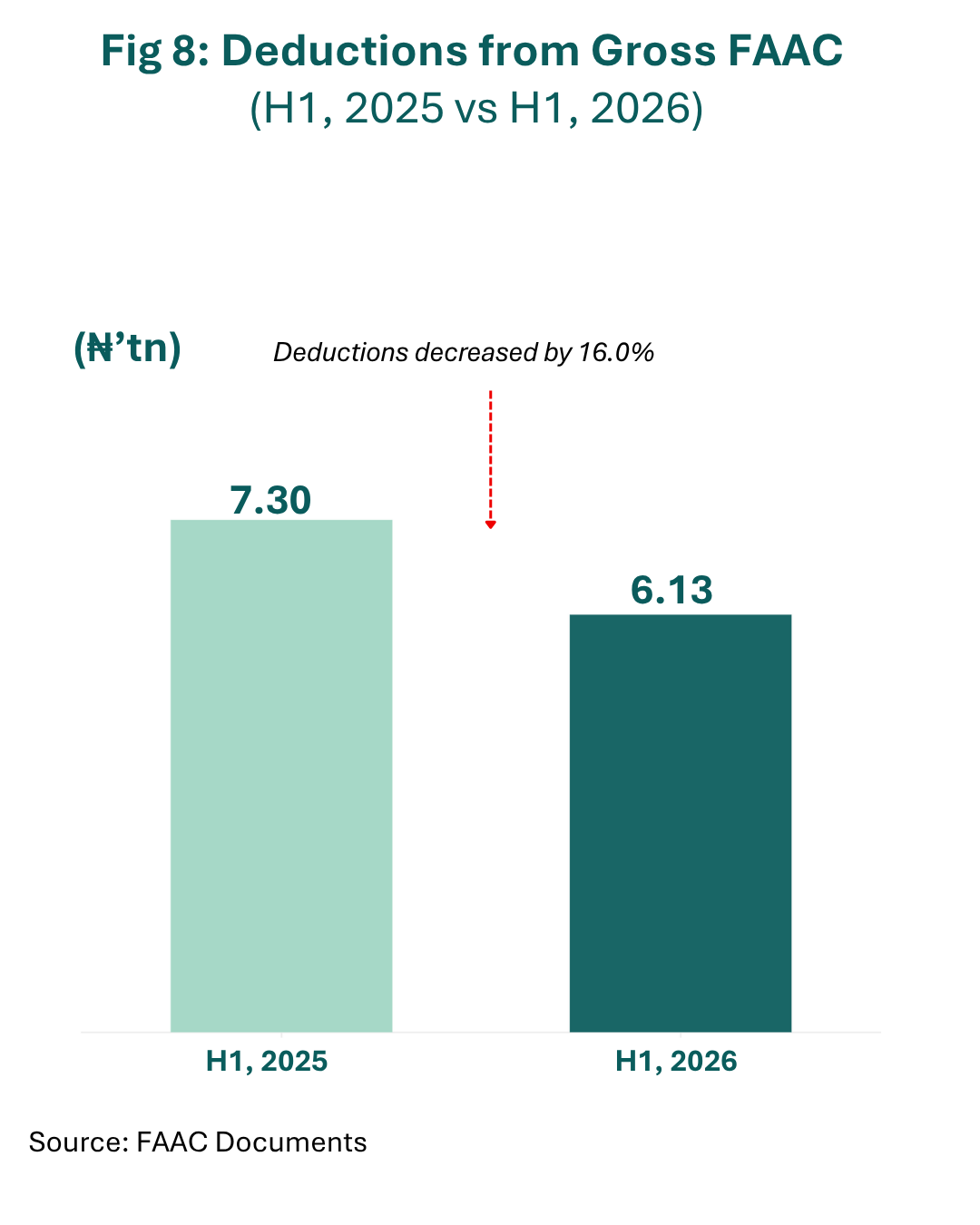
As a result, a larger share of Gross FAAC revenue was available for distribution, with distributable revenue accounting for 67% of Gross FAAC in H1 2026, up from 57% in the same period of 2025.
Less Refunds, More Savings
A notable highlight in FAAC revenue during the first half of 2026 was the sharp decline in refunds as seen in Fig 9. Refunds fell by 80% compared to the corresponding period in 2025, significantly reducing its share of FAAC deductions. In H1 2025, refunds, largely comprising payments to states and local governments, accounted for 47% of total FAAC deductions. By H1 2026, that share had dropped to just 12%.
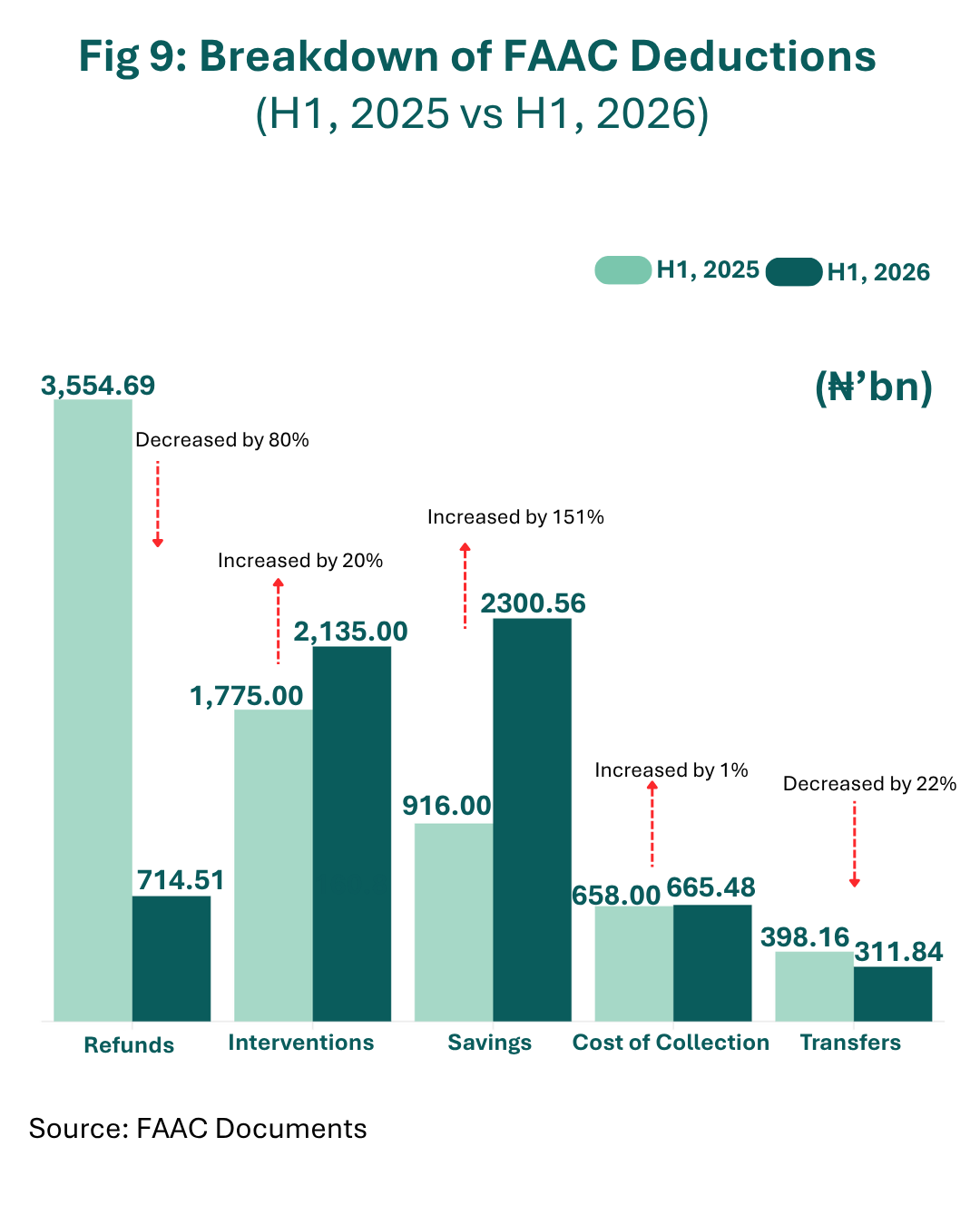
On the other hand, savings from Gross FAAC revenue increased substantially by 151% and became the largest component of FAAC deductions in H1 2026, accounting for 37% of total deductions from 15% in the corresponding period of 2025. Despite this, more money was allocated to Interventions between April to June 2026, particularly for national and state security, and state infrastructure. The breakdown of allocations to Interventions in the first half of 2026 is as follows: National Security Fund (₦ 1 trillion), Infrastructure Development Fund for States (₦777 billion), Military Intervention Fund (₦250 billion) and Intervention for State Security (₦108 billion).
Federal Government Regains Largest Share of Distributable FAAC Revenue
The distribution of Gross FAAC revenue shifted in favour of the Federal Government in the first half of 2026. Unlike the corresponding period of 2025, when the 36 states collectively received a slightly larger share of distributable FAAC allocations than the federal government, the federal government regained the top spot in H1 2026. In H1 2025, the states received a combined ₦3.43 trillion, marginally exceeding the Federal Government's ₦3.39 trillion as shown in Fig 10 below.

However, in H1 2026, the Federal Government's allocation increased to ₦4.57 trillion, surpassing the ₦4.47 trillion allocated to the states combined. However, a reallocation of the deductions (which go mostly to states) combined with derivation (which goes only to states), shows that the states get a higher portion of FAAC revenue than the FG.
June Remains the Month with the Highest Gross FAAC Revenue in the First Half of the Year
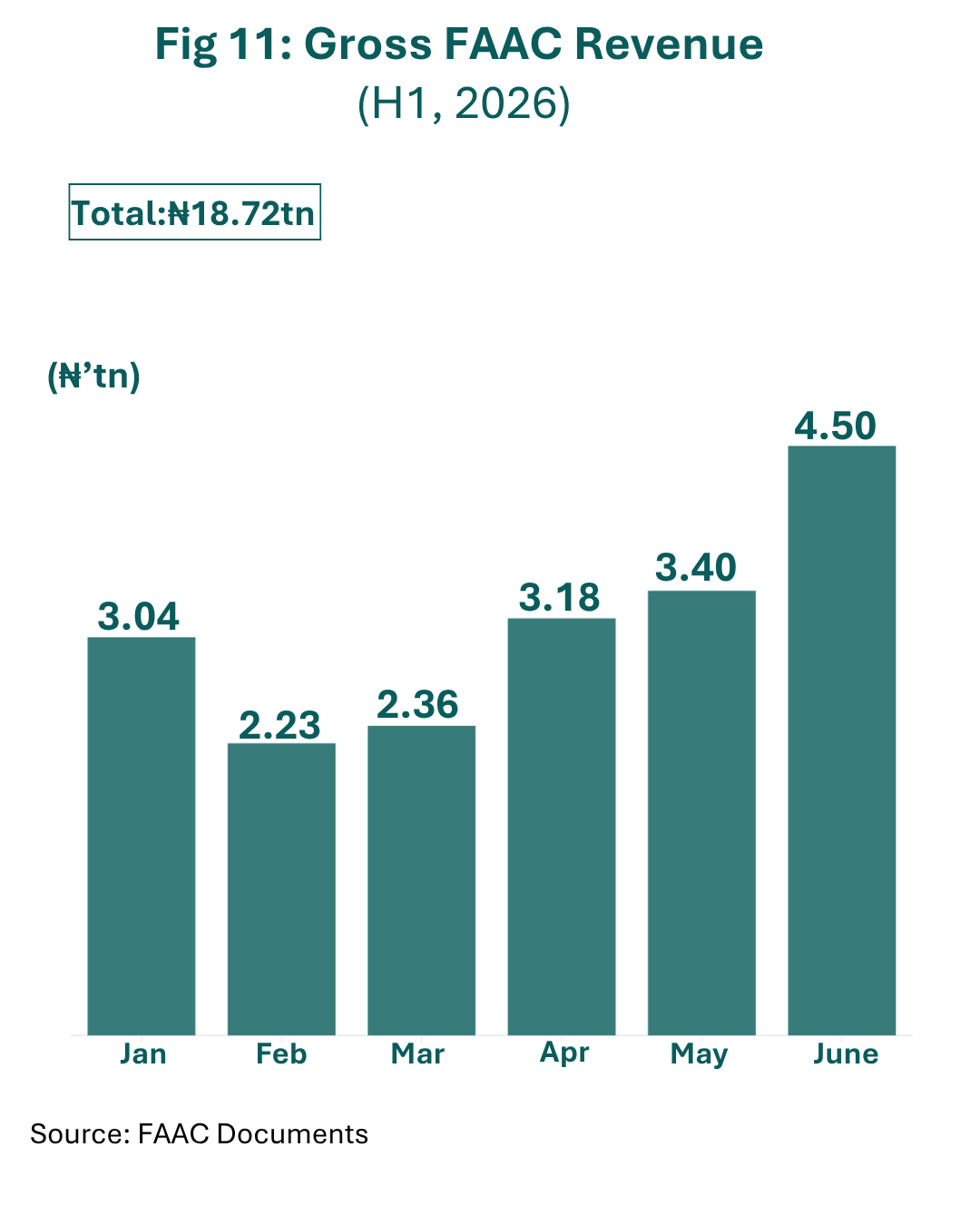
Just as it was in the first half of 2025, June recorded the highest Gross FAAC revenue in H1 2026 at ₦4.50 trillion as seen in Fig 11. This was likely driven by higher Company Income Tax (CIT) collections and other annual tax remittances typically due in June. In contrast, February recorded the lowest Gross FAAC revenue at ₦2.23 trillion, mirroring the trend observed in the corresponding period of 2025.
Lagos and Oyo Record the Highest Gross FAAC Increases
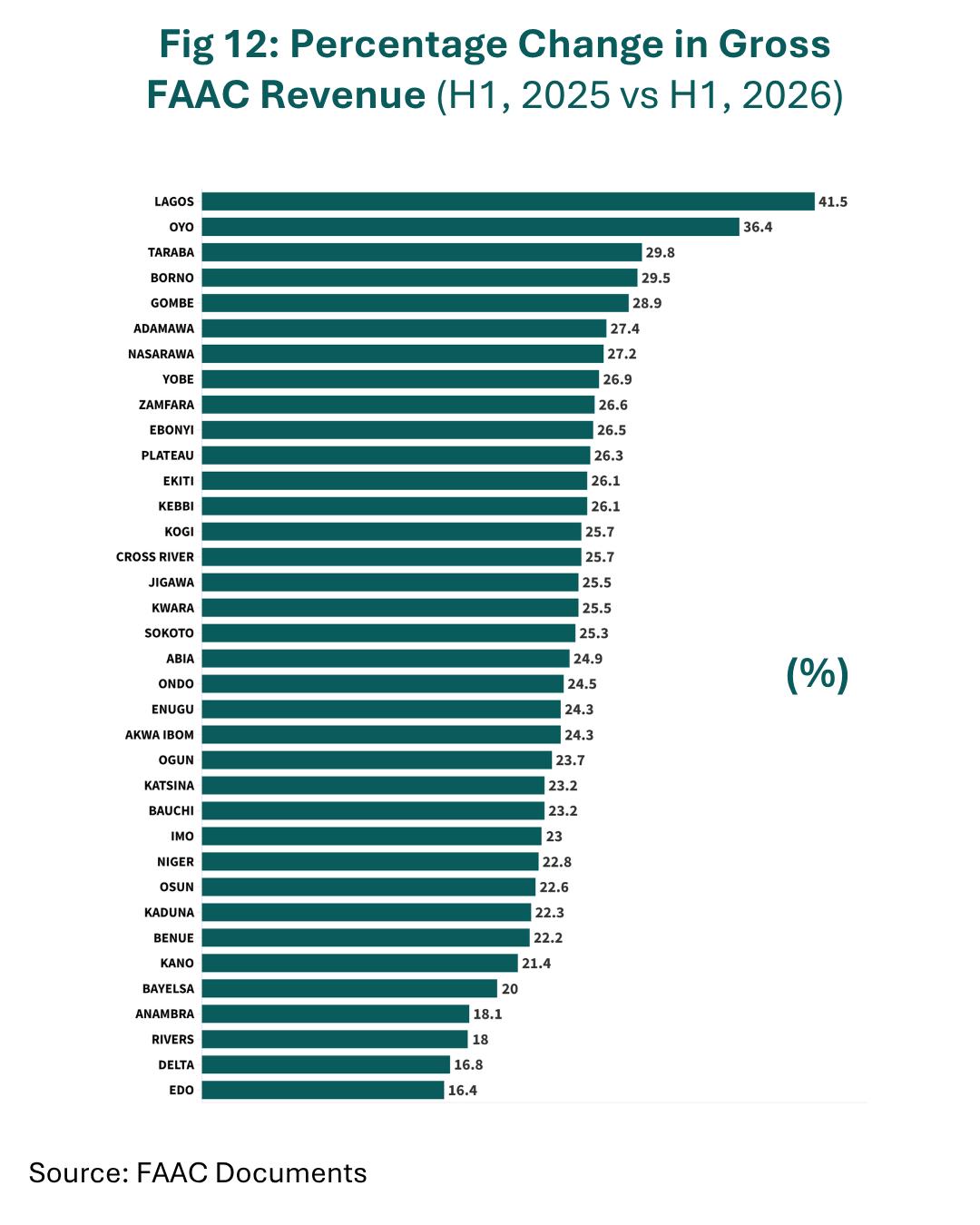
In terms of year-on-year growth, Lagos and Oyo states recorded the largest increases in Gross FAAC allocations by 41.5% and 36.4% respectively. By contrast, Edo and Delta posted the lowest increase with their allocations rising by 16.4% and 16.8%, respectively as shown in Fig 12.
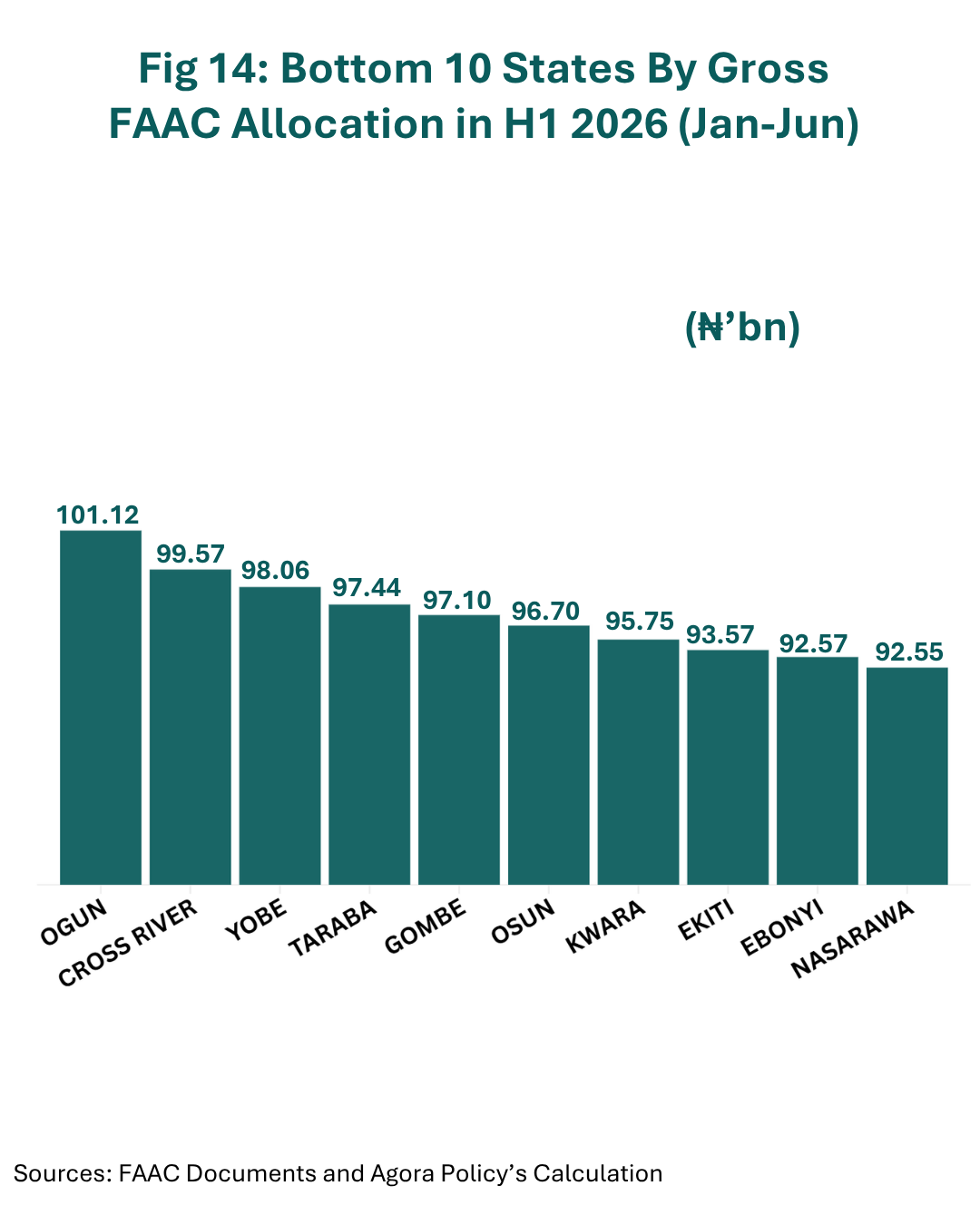
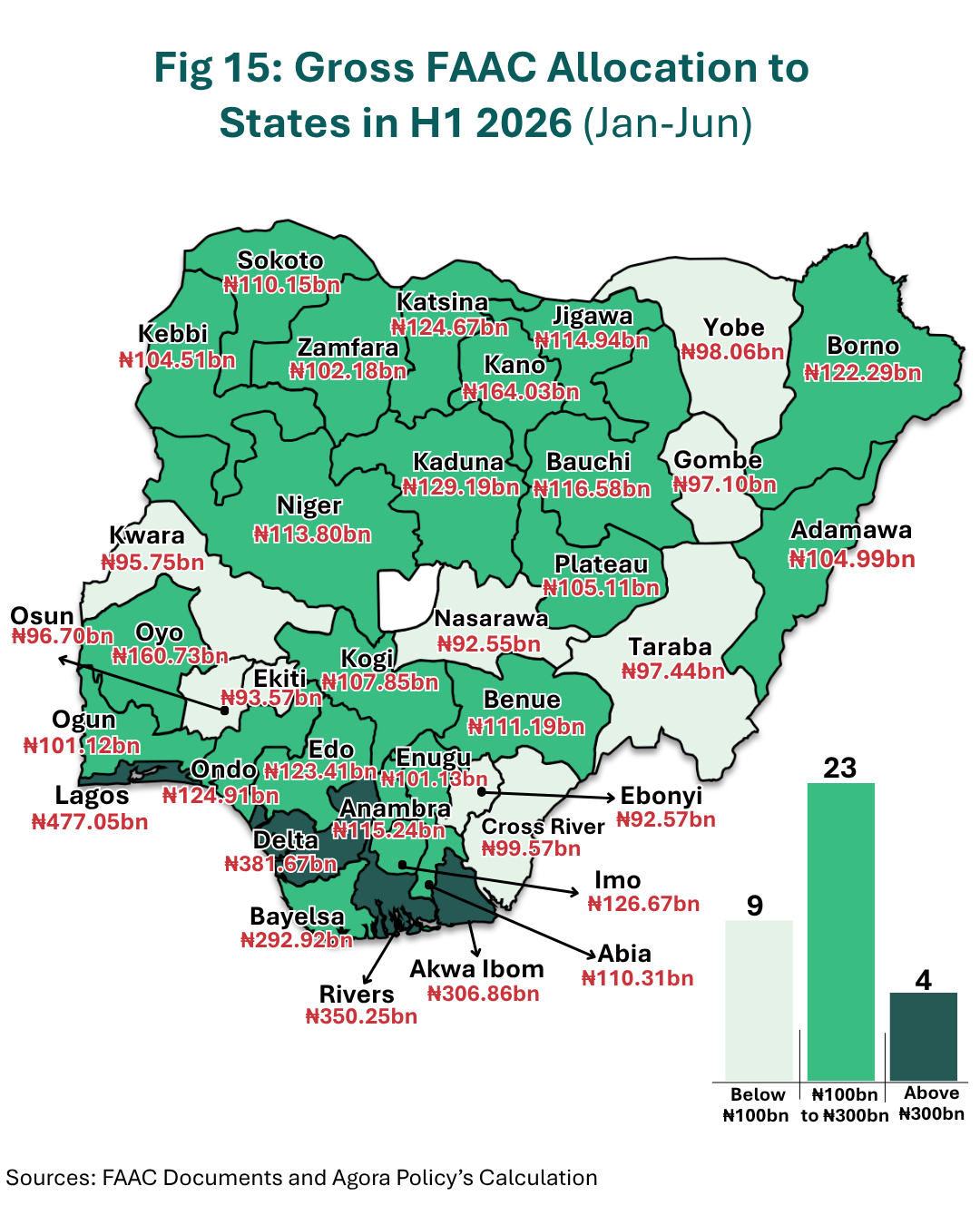
Meanwhile, Lagos remained the largest recipient of Gross FAAC allocations in the first half of 2026, receiving ₦477.05 billion, while Nasarawa received the least at ₦72.78 billion. The composition of the top and bottom recipients changed slightly compared to H1 2025. Ondo entered the top 10 states by Gross FAAC allocation, replacing Edo, which dropped out of the top 10. At the lower end of the ranking, Ogun joined the bottom 10 states, while Zamfara moved out of the group as seen in figures 13 and 14.

Twenty of the 36 states received between ₦100bn to ₦300bn in gross FAAC allocation. Nine states received less than ₦100bn while Lagos, Delta, Rivers and Akwa Ibom each received over ₦300bn as shown in Fig 15.
Having More LGAs Does Not Necessarily Mean Higher FAAC Revenue
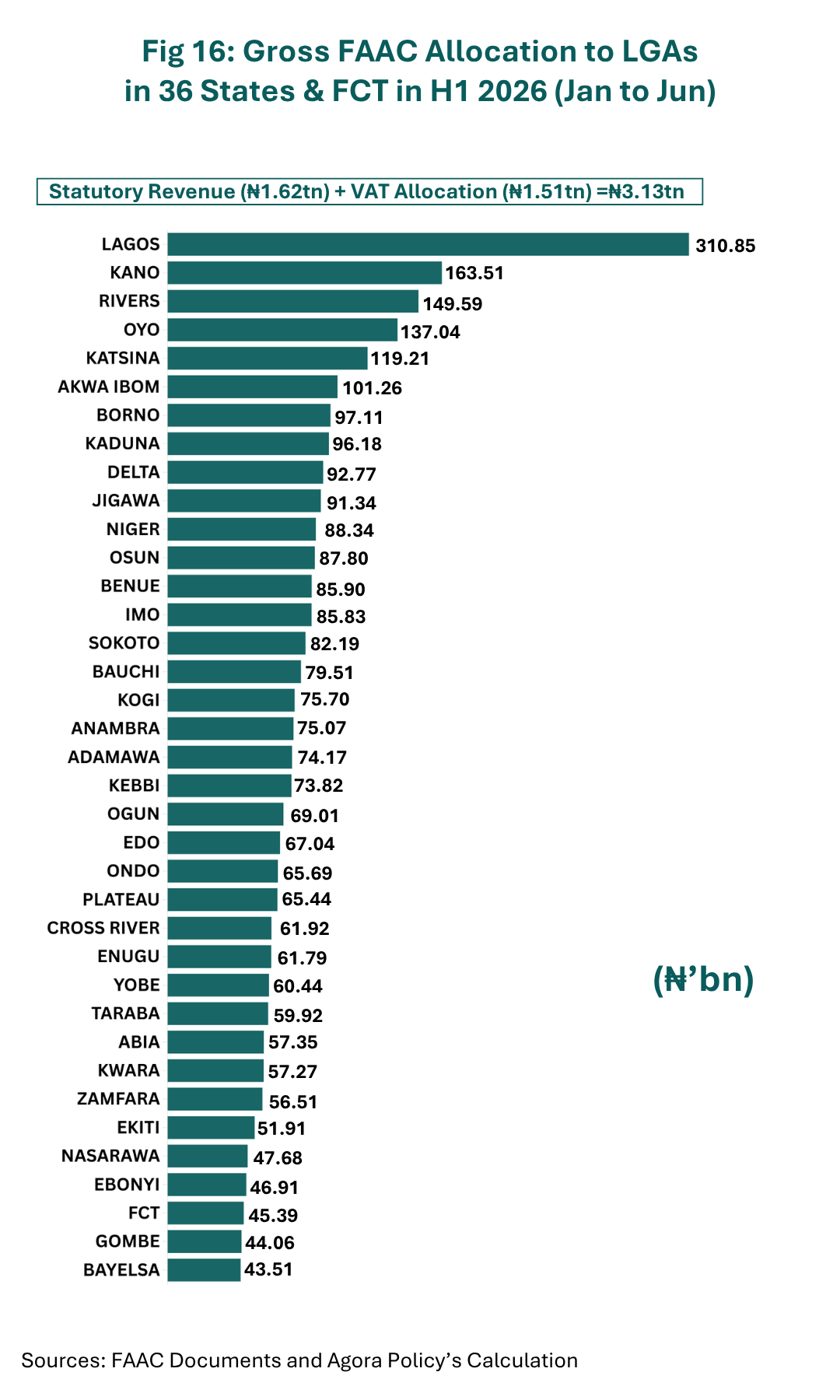
Although Kano has the highest number of LGAs (44), its combined gross FAAC allocation of ₦163.5 billion to its LGAs was only the second highest and was nearly half of the ₦310.85 billion received by the 20 LGAs of Lagos. Similarly, Rivers, with 23 LGAs, received a higher gross FAAC allocation to its LGAs than Oyo and Katsina, despite having 33 and 34 LGAs, respectively, as seen in Fig 16. This pattern appears recent, and is likely on account of the growing prominence of Value Added Tax (VAT) as a source of FAAC revenue. LGAs receive 35% of VAT revenue, and states with urban and commercial LGAs with a high level of consumption, like Lagos and Rivers, stand at an advantage, even with fewer number of LGAs.
Conclusion
The first half of 2026 marked a marginally better FAAC performance than the corresponding period of 2025, with higher gross FAAC revenue, a larger distributable pool, and lower deductions. But improved allocations alone may not translate to better development outcomes unless accompanied by more efficient spending across the three tiers of government. Equally important is the need to strengthen transparency and accountability mechanisms to ensure that public resources deliver measurable value for citizens. Therefore, as revenues improve, the emphasis should increasingly shift from the size of allocations to how effectively public resources are deployed to improve infrastructure, public services and the welfare of Nigerians.
Read more: Insights from FAAC Disbursements in the First Half of 2026
- Details
-
By Agora Policy
- Blog
- Hits: 5662
By Ayobami Ayorinde and Oluchi Nkeonye | Nigeria is set to rebase its Gross Domestic Product (GDP) and Consumer Price Index (CPI) a decade after it undertook a similar exercise.
Read more: Explainer on Planned Rebasing of Nigeria's GDP and CPI
- Details
-
By Agora Policy
- Blog
- Hits: 1644
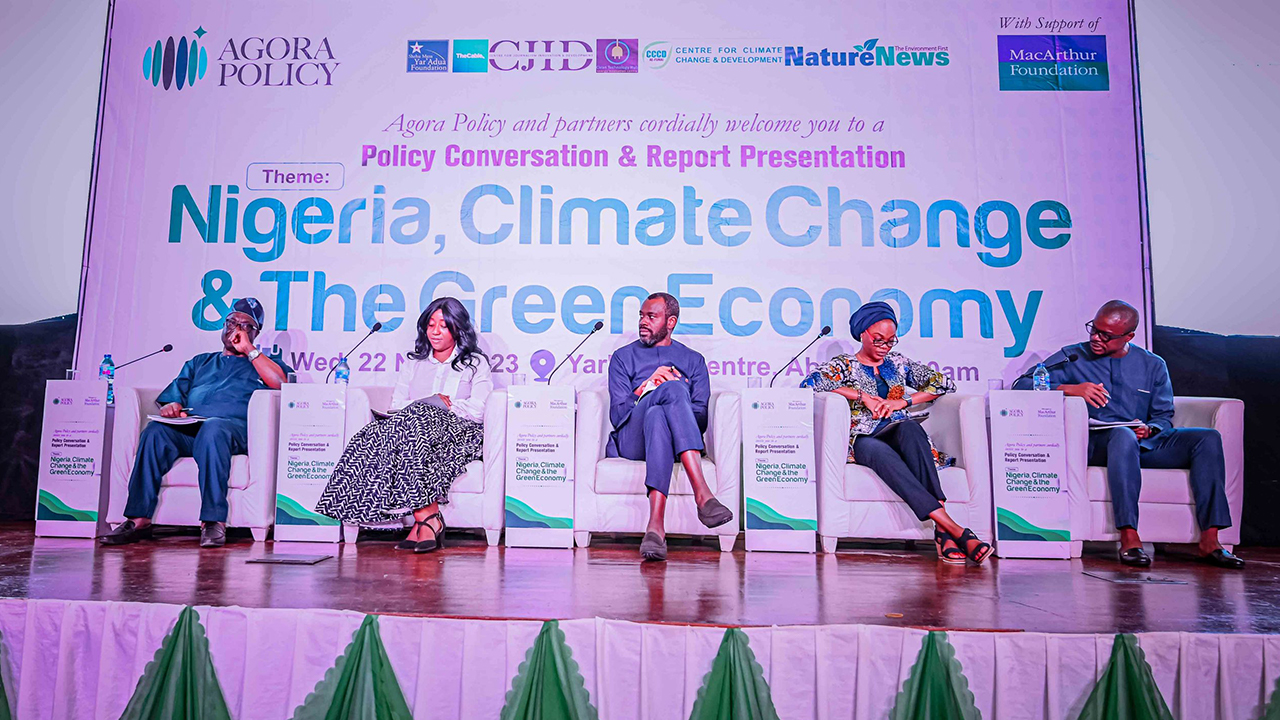
By Ifetayo Idowu and Faridha Salihu-Lukman | Last Wednesday, 22 November 2023, Agora Policy and partners convened a policy conversation in Abuja to explore the intersection between climate change, energy transition, and the green economy in Nigeria. The event also featured the public presentation of Agora Policy's latest report, entitled "Climate Change and Social-Economic Development in Nigeria," produced with the support of MacArthur Foundation, also the sponsor of the policy conversation.
From the remarks, goodwill messages, panel discussion, special interventions and the question-and-answer session, many ideas were offered and discussed about the state of climate change awareness and interventions in Nigeria and what the country needs to do to minimise the risks and maximise the opportunities of the global transition to cleaner energy.
Below are five of the key insights from the deliberation.
- Denial and defiance define national attitude to climate change in Nigeria
There was a clear consensus among the speakers that evidence abounds that climate change negatively impacts Nigeria through different channels and that it increases Nigeria’s exposure to hunger, poverty, diseases, and conflicts. There was also an agreement that the toll of climate change on the country will get worse if urgent action is not taken. However, that sense of urgency is hardly seen even within official circles in the country. Mr. Waziri Adio, the Executive Director of Agora Policy, said the national attitude on climate change “oscillates between denial and indifference.” According to Mr. Tayo Aduloju, the CEO-designate of the Nigeria Economic Summit Group (NESG), there is another dimension: defiance. "This defiance comes from perspective that climate change is not Africa's fault, not Nigeria's fault. Therefore, ignore it.”There was an agreement that these attitudes are not useful and need to change for the country to adequately adapt to climatic changes and appropriately position itself to benefit from energy transition.
- Climate change is a major, not marginal, challenge for Nigeria
In his presentation, Professor Chukwumerije Okereke emphasized that it is wrong to see climate change only from the lens of the environment. He submitted that it is more useful to see climate change as the key development challenge of the country. He stated: "Climate change is not a marginal environmental problem out there. But it is a major, perhaps the defining, socio-economic, geopolitical, demographic challenge facing Nigeria today." Other speakers echoed the same sentiment, calling for more urgent and bolder actions, and the need to mainstream climate change into national development plans.
- The poor and the vulnerable could be further disadvantaged
Various speakers argued that climate change imposes a disproportionate burden on the poor, the vulnerable and the marginalised and could further deepen inequality in terms of energy access and income in the country. Dr. Kole Shettima of MacArthur Foundation, Mrs. Funke Baruwa of Ford Foundation and Ms. Tengi George-Ikoli all made this point in various ways, and they all urged that climate policies be designed and implemented in an inclusive and collaborative manner, with special attention paid to ensuring that policies and actions bridge and not widen inequality in society.
- Showing benefits critical to optimising gains of the green economy
Climate change is not all bad news as the transition to cleaner energy offers Nigeria and others opportunities for improving energy access, creating jobs and increasing economic growth. According to the World Bank Country Director, Dr. Shubham Chaudhuri, Nigeria needs to strike a delicate but necessary balance between improving energy access and aligning with the shift towards a low-carbon world. For Mr. Abubakar Suleiman, it is important to demonstrate to various stakeholders that embracing renewable energy will help to save cost, increase profits, create job and grow the economy. “One language that every understands is their bottom-line,” he said, emphasising the need for government to stimulate demand for renewables and to invest in the alternative energy eco-system so that Nigeria can benefit from every part of the value-chain. For example, he argued, Nigeria should not just be interested in using solar panels but also in making them too. Ms. George-Ikoli reinforced this point by advocating that Nigeria should be keen on processing its green minerals, rather than just exporting them raw.
- Simplification should be an article of faith
Awareness about climate change is very low in Nigeria. Some of the speakers reckon that this is because the language adopted in communicating the issue is too technical for most people. There was a call to simplify the language and frame climate change in a way many Nigerians can understand and relate with. “We need to find a different nomenclature for the world climate change maybe then it will make more sense to policymakers and to the ordinary people," said Mrs. Baruwa. Dr. Shettima put it this way: "When you talk to Nigerians about climate change, most people don’t know what it is. But when you talk to Nigerians about flooding, they know what flooding is. When you talk to Nigerians about drought, they know what that means." Having a clear understanding of the meaning, impacts and opportunities of climate change will be critical to achieving an all-of-society and a coordinated approach that most speakers agreed is needed to move the needle on climate action in Nigeria.
- Details
-
By Agora Policy
- Blog
- Hits: 1734
Let’s start with the obvious: climate change still does not enjoy the prominence that it deserves in Nigeria. Yes, there are some individuals, organisations and government agencies that are making a strong case for, and designing and implementing, consequential climate interventions in the country. We salute them. We thank them.
But the sad, inconvenient truth is that climate change still does not rank very high on our policy agenda and in our popular imagination. Both in official circles and among the populace, climate issues are not seen as really important and urgent. Our national attitude oscillates between denial and indifference.
Most of our people, including highly-placed government officials, see climate change as other people’s problems or an issue that is only for tree-huggers and environmentalists, or something that should bother only those who have the luxury of not wrestling with hunger and other existential matters—as we say in Pidgin, “somtin for pipu wey don belleful.”
And because we are a people of fantastic faith, we simply think and believe that the negative impacts of climate change will never be our portion.
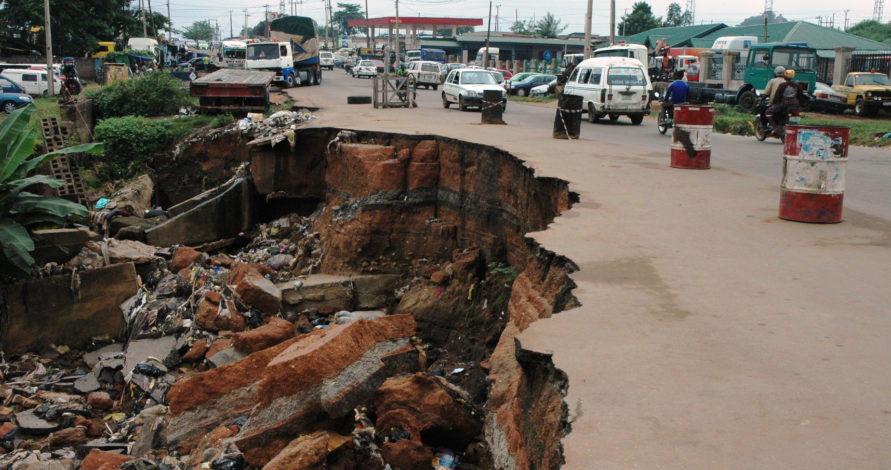
But the burdens of shifts in climatic conditions are already our portion. They are all around us. The rise in temperature, the irregular raining patterns, the near perennial flooding across the country, the increasing threats of desertification and gully and coastal erosions, and others already have deep, negative impacts on food production, food security and food inflation, and on water, on health and productivity, on energy and infrastructure, and on the conflicts that continue to multiply partly on account of vanishing natural resources.
Whether we want to accept it or not, whether we think it is other people’s or our own headache or not, whether we think it is our portion or not—climate change is already exerting a big toll on the things we consider critical and urgent. It is already here and now, not a matter of the hereafter. It is not what we can simply wish away by faith.
And because of its multi-dimensional, ramifying nature and multiplier effects, climate change is the most existential threat that we face already. And it is projected to get significantly worse within a few years. This silent crisis of today is likely to escalate into a catastrophic one soon—unless we act urgently, intentionally, and boldly.
There are additional reasons for greater urgency. We are a resource-intensive but ironically energy-poor country. The global transition away from fossil fuels poses grave threats to government revenue at all levels and to our capacity to provide the much-needed power for homes and industries.
Our capacity to fight poverty and achieve the SDGs and to increase national productivity and competitiveness may be further compromised. The transition away from fossil fuels may appear paused for now in the aftermath of Russia-Ukraine. But it won’t be paused for long.
In a related but significant vein, the energy transition is creating a new economy, an intense scramble for critical minerals already spurning instability around us, and a strategic positioning by countries to ensure that their interests are well served in the emerging economic order.
Where are we as a country in all of this? That’s a question for all of us to answer.
But let’s get this straight: we cannot afford to be a bit player in the emerging order except we are content with holding the short end of the stick or happy to be further consigned to the margins of existence.
We therefore need to see climate change as the central development challenge for our country, not in the future, but today.
And we need more than a conversation or the commitment of the converted. We need an all-of-society approach. From political authorisers to policy wonks to the ordinary persons on the streets and in the homes, we all have roles to play, and we all need to act differently.
*Excerpt from the welcome address by Waziri Adio, Founder/Executive Director of Agora Policy, at the policy conversation held on 22 November 2023 in Abuja.

Agora Policy is a Nigerian think tank and non-profit committed to finding practical solutions to urgent national challenges.