
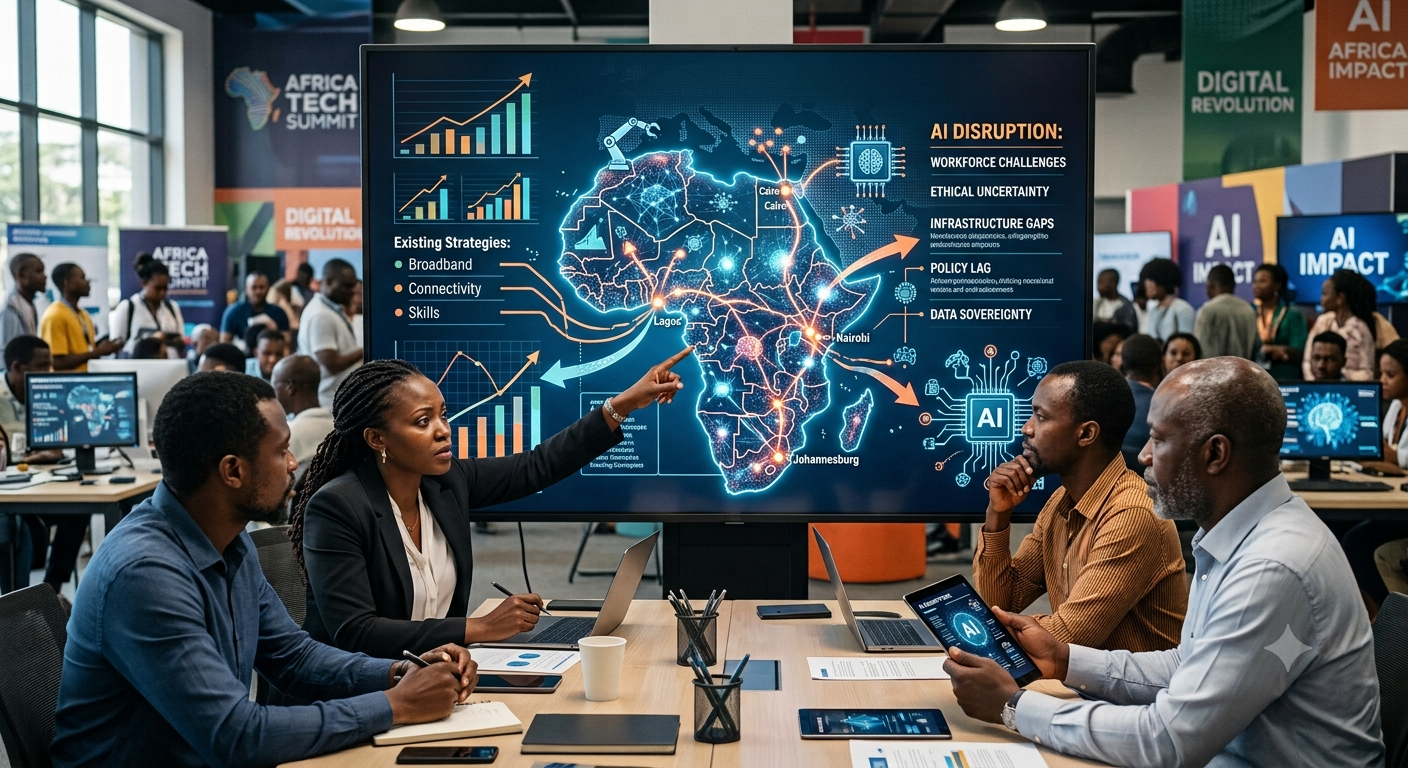
By Samuel Ajayi | Some African governments have built their digital strategies around exporting talent and services. Nigeria's National Talent Export Programme (NATEP) aims to create one million direct export-linked jobs, positioning the country as "a premier global talent hub" for IT-enabled services, business process outsourcing (BPO), and software development.
Ghana's government is seeking to develop BPO and digital services into formal export sectors alongside cocoa, gold and crude oil, with a target of 100,000 new BPO jobs. Rwanda's National Digital Talent Policy seeks to transform the country "from a consumer/importer to a producer/exporter of ICTs." These strategies share a common logic: that African workers can compete for digital work on labour cost, that the tools needed to do this will remain affordable, and that entry-level, service jobs build skills over time.
All three assumptions are fraying as AI capabilities grow.
The most direct threat is to the jobs themselves. More than one million Africans work in BPO and IT-enabled services, a sector worth roughly $35 billion. This is precisely the model AI is beginning to dismantle. On freelance platforms such as Upwork, writing projects declined 32% year-on-year in 2025, the steepest drop of any category. It is worthy of note that eleven of twelve categories in Upwork saw declines. As much as 40% of tasks in Africa's tech outsourcing sector may be affected by AI by 2030, and 68% of the BPO workforce is entry-level, with more than half of their tasks already automatable. Furthermore, as AI functionalities expand, the traditional competitive edge of low-cost labour is deteriorating, leaving many African economies without the necessary industrial foundations to integrate workers displaced by this automation.
The second assumption, that the tools will remain affordable and accessible, is being eroded from two directions at once. AI's appetite for memory chips has reallocated supply away from consumer electronics toward data centres, a development that is driving up handset prices. Within one year, smartphone shipments to Africa and the Middle East are expected to fall by more than 20%, with the cheapest segment hit hardest. Industry estimates point to chip-driven price surge of as much as 60% in markets such as Nigeria, pricing the ultra-budget handsets that millions depend on out of reach. Even where hardware is within reach, subscription costs remain a barrier, as monthly subscription for a basic frontier AI tool costs $20 , which in Nigeria is nearly half the national minimum wage.
But the deeper problem is that local talent cannot get the computing power needed to do research and build locally-relevant solutions. According to a paper released a little over a week ago by the International Monetary Fund (IMF), fewer than 25% of university students in Sub-Saharan Africa pursue STEM disciplines, compared with roughly 40% globally. According to UNESCO, Africa will need an estimated 23 million additional STEM graduates by 2030 just to meet demand. And even where talent exists, lack of access to processing power is a severe bottleneck: only 5% of Africa's AI researchers have reliable access to the powerful computers required for their work. Data from the IMF underscores a stark developmental divide: while a researcher in the United States of America might refine an AI model every half-hour, their peer in Sub-Saharan Africa faces a six-day wait for a single training cycle to conclude. This severe disparity in access to processing power accelerates the flight of human capital toward resource-rich markets, further entrenching the regional brain drain that national digital strategies are desperately attempting to mitigate.
The third assumption and the most crucial is that the path exists at all. It is an assumption in need of closer scrutiny on two grounds. One, Africa holds roughly 1% of global data-centre capacity despite accounting for about 18% of the world's population. Existing facilities provide roughly 0.4 gigawatts of electricity capacity, the equivalent of a single large power plant. This is a major constraint. Two, only seven of Africa's 54 nations have a national AI strategy, and the processing power, talent and funding that do exist are concentrated in just three countries: South Africa, Nigeria and Kenya. The share of people using AI in Africa sits at 9.1%, compared to 25.5% in Europe.
According to the IMF, productivity gains from AI in Sub-Saharan Africa are projected at only 0.2 to 2.1% over the next decade — well below advanced economies. Even with faster adoption, which could raise median gains to around 2.1% and add half a percentage point to annual GDP growth, those gains depend on complementary investments in electricity, connectivity and skills that are largely absent. The African Development Bank projects that AI could account for $1 trillion in additional GDP to African countries by 2035, but that is conditional on infrastructure and training ecosystems that would require sustained public investment. Furthermore, fiscal constraints are tighten across the continent, with over 50% of Sub-Saharan Africa's low-income nations categorised by the IMF as either being in debt distress or facing a significant risk of it. The imperative to fund AI capacity must contend with the immediate, competing pressures of poverty reduction and the provision of essential social services.
The same AI systems that automate entry-level BPO work also drive the chip demand that raises handset prices, and both depend on infrastructure that barely exists. The promise of AI was that it would become an economic enhancer — a tool that raises productivity across agriculture, health, education, and manufacturing, and not just for desk-based professionals in wealthy countries. That promise is under threat in Sub-Saharan Africa, not because the technology falls short, but because the conditions needed to capture and optimise its value are not in place. Without deliberate action, AI will likely further entrench global inequality rather than reduce it.
What Can Policymakers Do?
To address the job squeeze, policymakers must look beyond formal-sector training. 83% of jobs on the continent are informal (93% in Nigeria), concentrated in agriculture, trade, and transport. Nigeria's 3 Million Technical Talent (3MTT) programme, launched in late 2023, aims to train three million Nigerians in digital skills, with over 135,000 participants so far, and has been extended through private-sector partnerships including a Microsoft commitment to train one million Nigerians in AI. This model is promising but must be reoriented to match new realities: expanded to include AI-specific training and extended to workers in the informal sector through offline-capable and context-aware means (such as what an organisation like Apollo Agriculture is doing using machine learning, remote-sensing data, and mobile networks to provide smallholder farmers with localised predictive crop advice and financing.) This would unlock latent economic potential and also become new grounds for innovation. Skills transition programmes must also specifically target BPO and freelance workers whose entry-level tasks are most exposed to automation.
To address the infrastructure deficit, African countries should pursue special cooperative agreements with leading technology powers and companies to co-invest in AI infrastructure. These agreements can follow models like the Cassava Technologies and NVIDIA partnership which is working on deploying 12,000 advanced processing chips across the continent. But these deals must be structured to protect sovereignty: clear data residency requirements, local ownership stakes, and governance frameworks that prevent a new era of digital dependency.
Tax policy can also help. Nigeria's new Economic Development Tax Incentive offers qualifying companies in priority sectors a 5% annual tax credit on capital expenditure for five years. If data centres and AI infrastructure are explicitly included, a firm building a $200 million facility would earn $10 million in credits — and those credits can be tied to measurable outcomes like the amount of surplus power supplied either as on-grid or captive electricity. This creates a virtuous cycle: companies build on-site power generation, consume what they need, feed the rest to the larger society, and earn tax relief in return. The country gets additional power, the company gets an incentive that rewards power production, and the government gets infrastructure without borrowing.
Regulatory reform matters too. South Africa's Energy Action Plan allowed private generators to sell power directly to private buyers using the grid — a practice common in the West but rare in Africa. The policy shift spurred a surge in renewable investment and helped end years of loadshedding. Similar reforms, combined with regional cooperation on processing infrastructure like the Africa Green Compute Coalition endorsed by the G7, can help smaller countries pool demand and negotiate collectively.
To improve access to AI tools, policymakers should build on existing models. Google's Gemini Access for Students programme, which provides eligible university students in Ghana, Kenya, Nigeria, Rwanda, South Africa, and Zimbabwe with free premium AI access for one year, points to what scaled public-interest licensing could look like. The Africa Compute Fund is building sovereign high-powered processing networks to provide production-grade environments for universities and research institutions. Meanwhile, initiatives like LINGUA Africa, backed by Microsoft, the Gates Foundation, and Google, combine cash grants with cloud processing credits for African AI researchers working on local-language tools. Subsidies for computing power and cloud services should be expanded and targeted at students, researchers and small enterprises. Policy must treat access to intelligence as a matter of public digital infrastructure rather than just a consumer product.
The current digital strategies of some African countries may have been blindsided by growing AI capabilities, but responding smartly and promptly presents an opportunity to ensure that AI becomes a tool for broad prosperity rather than reinforcing current inequality.
References
- NATEP — National Talent Export Programme
- BusinessDay — "Inside Nigeria's new blueprint to compete in the global digital services economy"
- NewsGhana — "Ghana Bids to Become Africa's Digital Outsourcing Hub"
- Citi Newsroom — "Positioning Ghana as a leading outsourcing & digital services hub"
- Rwanda National Digital Talent Policy (PDF)
- Mastercard Foundation — "Preparing For AI In The BPO And ITES Sector In Africa"
- Mastercard Foundation — "40% Of Tasks In Africa's Growing Tech Outsourcing Sector May Be Affected By AI By 2030"
- Vollna — Upwork Projects Analysis 2025
- IDC — Smartphone shipment data; Canalys — Africa smartphone market
- Nigeria National Minimum Wage Act, 2019; OpenAI ChatGPT Plus pricing
- IMF — "Unlocking the Potential: AI in Sub-Saharan Africa"
- UNESCO — "What you need to know about the challenges of STEM in Africa"
- UNDP — "Only five percent of Africa's AI talent has the compute power it needs"
- FDI Intelligence — Africa's digital infrastructure gap
- CSIS — "AI Strategies and the Informal Economy: Africa's Job Creation Test"
- Oxford Government AI Readiness Index
- Microsoft AI Diffusion Technical Report, 2025
- African Development Bank — AI for Africa
- ILOSTAT — Informal employment data
- 3MTT Nigeria
- Cassava Technologies and NVIDIA partnership
- Nigeria Economic Development Tax Incentive (EDTI)
- Semafor — "Africa's data center growth needs power sector overhaul"
- Africa Green Compute Coalition
- Google — Gemini Access for Students
- Africa Compute Fund
- LINGUA Africa — Microsoft AI for Good Lab
- World Economic Forum — "Investment in green computing can unlock $1.5t in Africa"