
By Suleiman Shehu | With macroeconomic stabilisation underway, Nigeria is again asking how to turn stability into sustained growth. The country has been here before: structural adjustment in the 1980s and the reforms of the early 2000s, the latter helped by high oil prices and the 2005 Paris Club debt deal, both restored a measure of stability.
Yet these episodes raise a question that remains relevant today: what happens after stabilisation? Improved macroeconomic conditions can create the space for investment and growth, but they do not determine whether firms expand production, capabilities accumulate, or industries become competitive. With more than 63 percent of the population under 25 and more than 12 million additional people expected to enter the 15–24 age group over the next decade, Nigeria will need to create productive employment at a scale it has not achieved before. Manufacturing is likely to remain an important part of that process, given its ability to generate employment, create domestic linkages, stimulate learning and support exports.
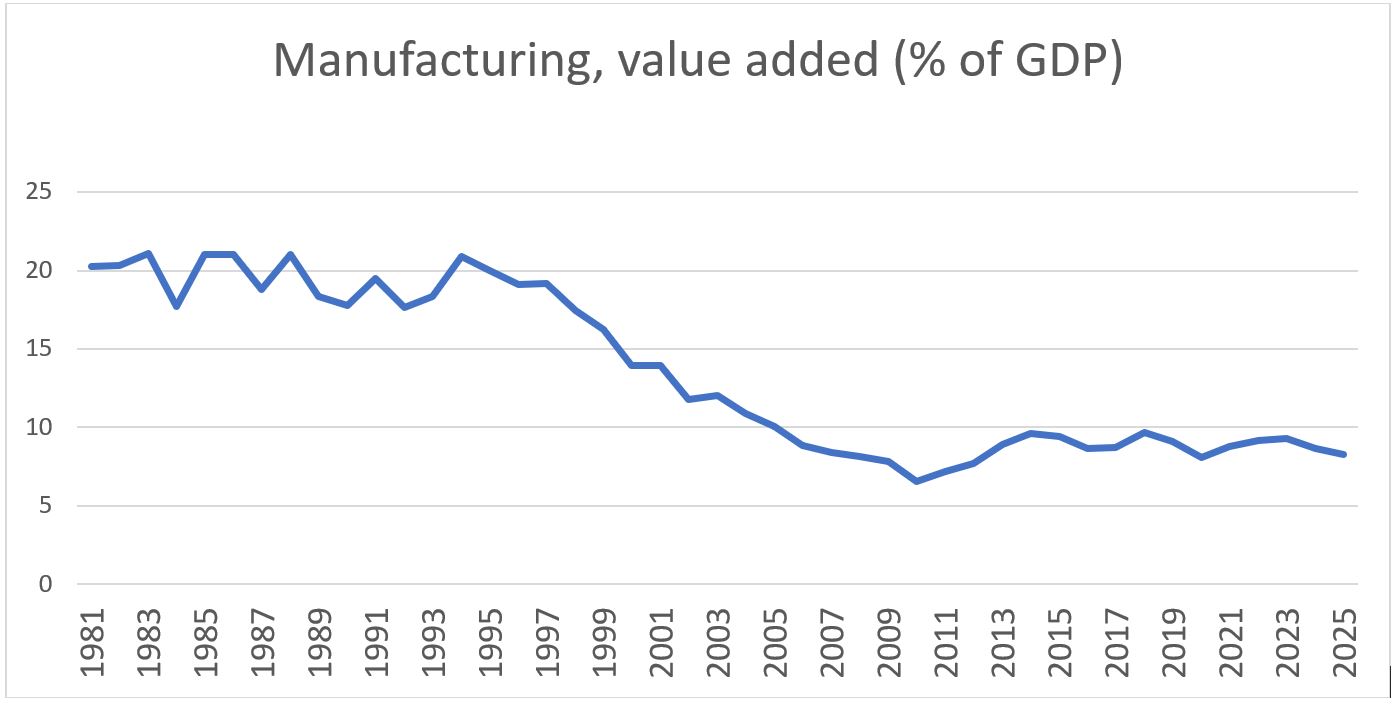
Figure 1: Nigeria’s manufacturing value added as a share of GDP, 1981–2024
Source: World Bank (2026), World Development Indicators.
Figure 1 shows the long decline in manufacturing’s relative importance. Manufacturing accounted for around one-fifth of GDP in the early 1980s, but its share fell substantially over the following decades and remained below 10 percent in 2024. Nigeria has accumulated six decades of industrial experience: firms have entered and exited, capabilities have been built and lost, and public resources have been directed toward industrial transformation. Yet the lessons from that experience are rarely carried clearly from one policy episode to the next. The Nigeria Industrial Policy 2025 follows the Nigeria Industrial Revolution Plan (NIRP) of 2014. Does the new policy build on what happened under NIRP, and under the policies before it?
Some interventions have generated substantial investment and domestic production; others have produced capacity without sustained output. Repeated attempts to revive some industries have struggled to restore lost capabilities. Rather than asking only which sectors Nigeria should prioritise, which instruments it should use, or which countries it should emulate, this essay asks what Nigeria’s own industrial experience reveals about the conditions under which productive capabilities are built, sustained and upgraded. The essay examines three industries: automotive, cement and textiles. Automotive was targeted for the breadth and depth of its linkages. Cement is one of the clearer cases of sustained industrial expansion since the start of the Fourth Republic in 1999. Textiles was one of the largest industries Nigeria built after independence and one of its biggest employers. Together they show three trajectories: investment without sustained production, sustained expansion, and decline.
Nigeria’s obstacle is not that it lacks lessons but that it has seldom learned from them. At the level of firms, one capability that matters greatly is tacit know-how, acquired largely through production itself: in textiles it was hollowed out from the 1990s; in automotive it never grew beyond assembly; and, of the three, only in cement has it accumulated. At the level of the state, the problem is less visible. The evidence on these industries is largely aggregate, so policy tends to begin each round with little systematic knowledge of what happened in the last.
This is not a call for more monitoring and evaluation. It is a call for turning contextual experience into a diagnosis of what constrains production after investment, and for letting that diagnosis shape the next policy. A recent memo by Agora Policy argues that Nigeria has relied on protection and discretionary incentives while underinvesting in the public inputs that make firms competitive. The three cases that follow take this a step further, tracing what happened after investment arrived and what that record suggests the next policy should learn.
Automotive: Investment Without Sustained Production
In the 1970s and 1980s, Nigeria had an emerging automotive industry, with several multinational manufacturers, including Peugeot, Mercedes-Benz, Leyland and Steyr, operating assembly plants that used completely knocked-down (CKD) kits. However, the country struggled to move beyond assembly and develop domestic capabilities to supply components and replacement parts. The economic crises of the 1980s subsequently weakened the operating environment, raising the cost of assembly and contributing to the exit of several multinational firms. Responding to the growing volume of second-hand vehicle imports and the sector’s potential linkages to the wider economy, the government in 2013 developed the National Automotive Industry Development Plan (NAIDP). The NAIDP envisaged a progression from the assembly of CKD and semi-knocked-down (SKD) vehicles toward greater local production, including supplier development and replacement components. The plan sought to encourage this transition through financial and trade incentives, including tax breaks, a vehicle purchase scheme, higher tariffs on imports of fully built-up vehicles, and lower tariffs on imported kits, while also supporting indigenous producers such as Innoson Vehicle Manufacturing through government purchases. Figure 2 shows how limited the sector has remained. After peaking at about 3.2 percent of GDP in the early 1980s, motor vehicle manufacturing and assembly declined sharply and contributed very little to GDP in the following decades. The contribution remained small even after the introduction of NAIDP.
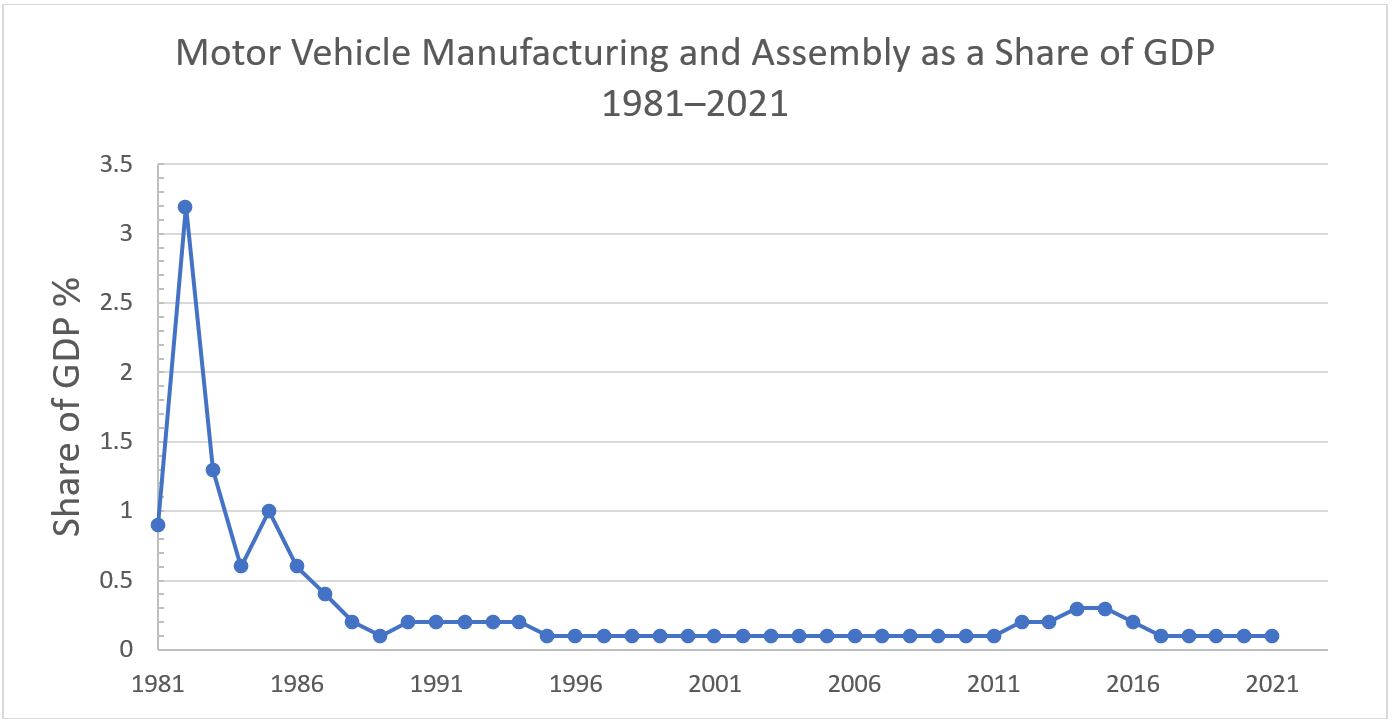
Figure 2: Motor vehicle manufacturing and assembly as a share of GDP, 1981–2021. Source: Adapted from Agarwal et al. (2023), ODI.
The implementation of NAIDP was followed by a clear investment response. Some 58 assemblers invested about $756 million between 2014 and 2024, as multinational-linked and indigenous firms established or expanded operations, though only six remain active. However, the increase in investment and installed capacity did not translate into comparable levels of production. The 2016 recession weakened many of the conditions that policy had sought to improve. The new auto tariff, combined with naira depreciation, caused vehicle prices to roughly double between 2014 and 2016, while sales fell by more than 60 percent. Assemblers sourced foreign exchange from the parallel market and, by 2016, were operating at 10–20 percent of capacity. Higher interest rates weakened vehicle finance. The constraints interacted: higher input costs raised vehicle prices; higher prices constrained demand; weak and uncertain demand reduced plant utilisation; and low utilisation made it difficult for firms to achieve the scale economies required to reduce unit costs. Actual vehicle production was estimated at only 14,000 units in 2020, while installed capacity was far higher, as Figure 3 shows.
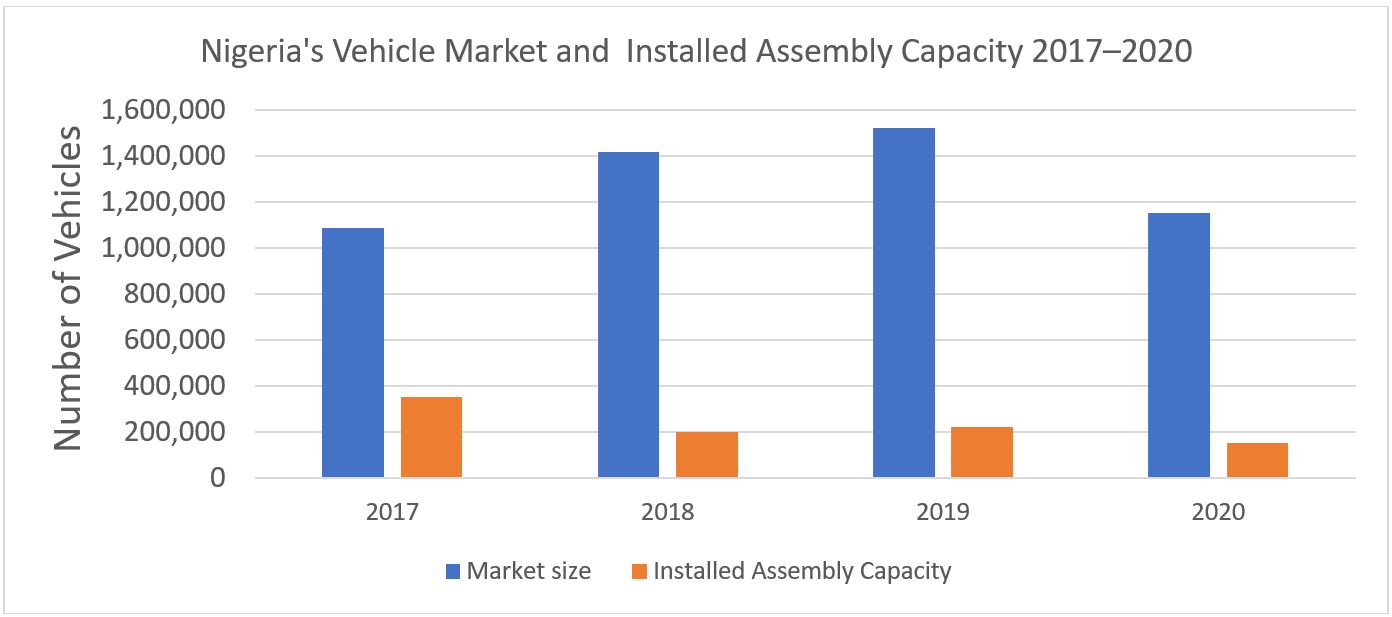
Figure 3: Nigeria’s vehicle market and installed assembly capacity, 2017–2020. Source: Adapted from Agarwal et al. (2023), ODI.
NAIDP envisaged that sustained assembly would create demand for domestic components and replacement parts. But component manufacturers require sufficiently large and predictable orders to justify investment. Deeper localisation would also require reliable and competitively priced electricity, engineering skills, standards, finance, and access to materials and intermediate inputs. These conditions were needed for firms to compete and for the industry to move beyond assembly. The government also faced a difficult trade-off. The protection that encouraged domestic assembly also increased the cost of imported vehicles in an economy heavily dependent on road transport and with limited consumer credit. The Finance Act of 2020 then eroded part of the relative price advantage on which local assembly had depended, cutting the levy on imported cars from 35 percent to 5 percent while leaving import duty at 35 percent. Innoson’s continued operation raises a related question. It does not establish greater competitiveness or deeper local capability, but it suggests that indigenous and multinational firms may respond differently to the same policy and operating environment. One interpretation of NAIDP is that industrial transformation was interrupted rather than absent. Policy changed the conditions for assembly, and investment followed, but those conditions appear to have been vulnerable to macroeconomic deterioration before firms reached sufficient scale.
Cement: From Scale to Market Power
Cement provides a contrasting experience. Cement production in Nigeria dates to the 1950s, but domestic supply remained insufficient to meet demand for decades. By the late 1990s and early 2000s, rising construction activity and urbanisation had made cement a major import. The Backward Integration Policy (BIP), introduced in 2002, sought to change this through import protection, tax incentives, import-licensing arrangements and commitments by importers to establish domestic production. The privatisation of state-owned plants also brought in firms with the financial and technical capacity to expand. The policy was also shaped by its political context. The cement entrepreneurs combined strong financial and organisational capabilities with political importance to ruling elites. This helped sustain support for the BIP and its enforcement. In contrast, capable textile firms, many of them foreign-owned and operating in a more competitive industry, had less influence over policy. The response was substantial: by 2014, local production exceeded 20 million tonnes, while imports had fallen to a very small share of the market. Figure 4 shows a shift from dependence on imported cement toward domestic production.
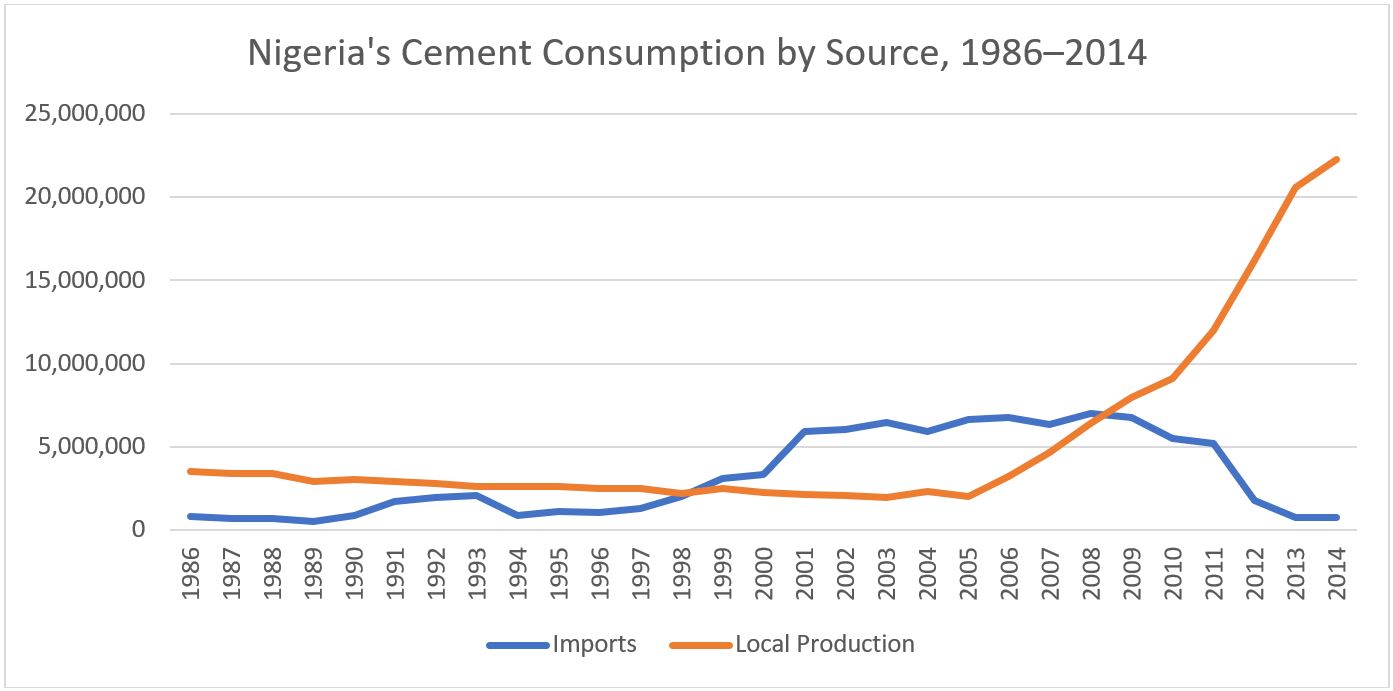
Figure 4: Nigeria’s cement consumption by source, 1986–2014.
Source: Salihu (2025).
The rise in cement output was made possible by a combination of factors: a relatively favourable macroeconomic environment, supportive government policies such as the Backward Integration Policy, growing construction demand, the availability of key inputs such as limestone, and the capabilities of the firms operating in the sector. Cement's production structure also played a part: it has high fixed costs, but if a firm can sustain production at scale, the rewards are significant. Furthermore, the industry’s relatively short supply chain, from quarrying to processing and distribution, made it easier for capable, large firms to invest in logistics and captive power and to manage some foreign-exchange constraints. As output expanded, firms could spread fixed costs over larger volumes and reinvest. Dangote Cement, for example, reinvested, on average, almost half of its profits between 2010 and 2017. The process seems to have become cumulative: policy created the opportunity, capable firms invested, constraints were partly managed, production reached scale, and scale supported further investment. Morocco built a cement industry with similar policies.
However, the bargain behind the policy was only partly met. Protection, tax holidays and access to limestone were provided in exchange for a self-sufficient domestic industry and affordable cement. Self-sufficiency was reached by 2012, and by 2024 installed capacity had grown to roughly 65 million tonnes, almost twice domestic demand. Affordability has not followed: the main producers earned estimated operating margins of about 49 percent in the first nine months of 2025, well above producers in other markets, and cement is exported at prices below those charged in Nigeria. The explanation lies in market structure: cement is a concentrated oligopoly in which the leading producer, holding more than half of installed capacity, sets prices that rivals follow. Transport costs divide the country into regional markets where individual plants face little competition, and long-term limestone concessions restrict entry. Capacity itself has become strategic: producers continue to expand despite the surplus, which deters new entrants. Elements of the policy package that built the industry, together with the capabilities firms developed under it, now help sustain the incumbents’ dominance.
Textiles: Rebuilding What Was Lost
The textile industry represented one of Nigeria’s most ambitious attempts at industrialisation in the 1970s and 1980s. Under import substitution, high tariffs, preferential access to foreign exchange, tax exemptions and subsidies helped the industry expand to approximately 175 firms by the mid-1980s, employing an estimated 350,000 workers. Liberalisation and changes in fiscal and foreign-exchange policy under the Structural Adjustment Programme (SAP) subsequently exposed domestic producers to greater competition and increased the cost of imported inputs. The sector contracted through the 1990s and fell most sharply after 2000, from 85 mills to 25 by 2005 (Figure 5).
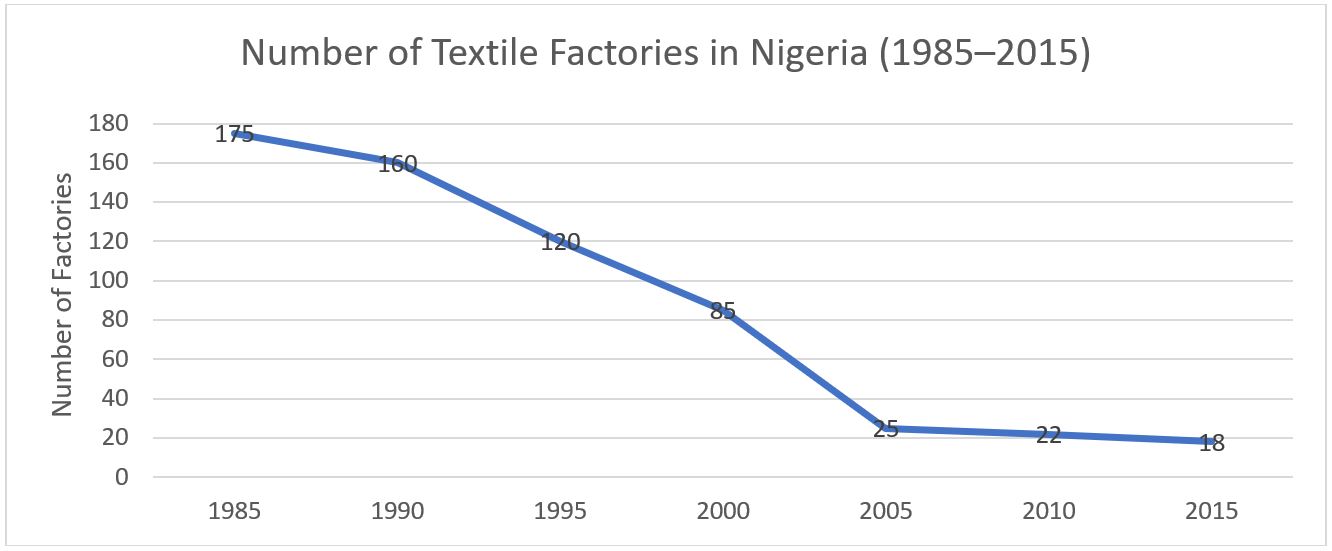
Figure 5: Collapse of Nigeria’s textile industry, 1985–2015. Source: Muhammad et al. (2017).
The decline went beyond the factories themselves. As production disappeared, so did parts of the ecosystem around them: suppliers, technicians, maintenance networks, production knowledge and commercial relationships. Nigeria therefore lost not only capacity but also productive capabilities that are difficult to recreate quickly.
Successive governments have nevertheless tried to rebuild the sector through finance, tariffs and import restrictions, cotton development, support for mills and programmes covering the wider cotton–textile–garment value chain. More than ₦500 billion has been committed to interventions over three decades, while the government has also tried to create demand through public procurement, with federal MDAs directed to give preference to locally manufactured goods, including uniforms and footwear. Yet the results have been uneven. Support for cotton has not automatically translated into stronger downstream textile production, while finance and protection have not restored the sector to anything close to its former scale. Import restrictions can create market space for domestic producers, but where firms cannot supply competitively, price differences create incentives for smuggling.
This raises a more fundamental question: what conditions are required to build a viable textile industry? Most textile revitalisation plans have treated cotton, textiles and garments as one value chain that must be rebuilt together, but the production requirements differ. A garment producer can import its most crucial inputs, such as fabrics, chemicals and other intermediate inputs, rather than source them locally. A textile producer, by contrast, must operate spinning, weaving and finishing processes competitively, requiring reliable power, machinery and maintenance, technical skills and access to intermediate inputs. The difference in the investment required is large. Suppliers interviewed in one recent study put a new garment factory at about $1 million and a new textile mill at $50 million or more.
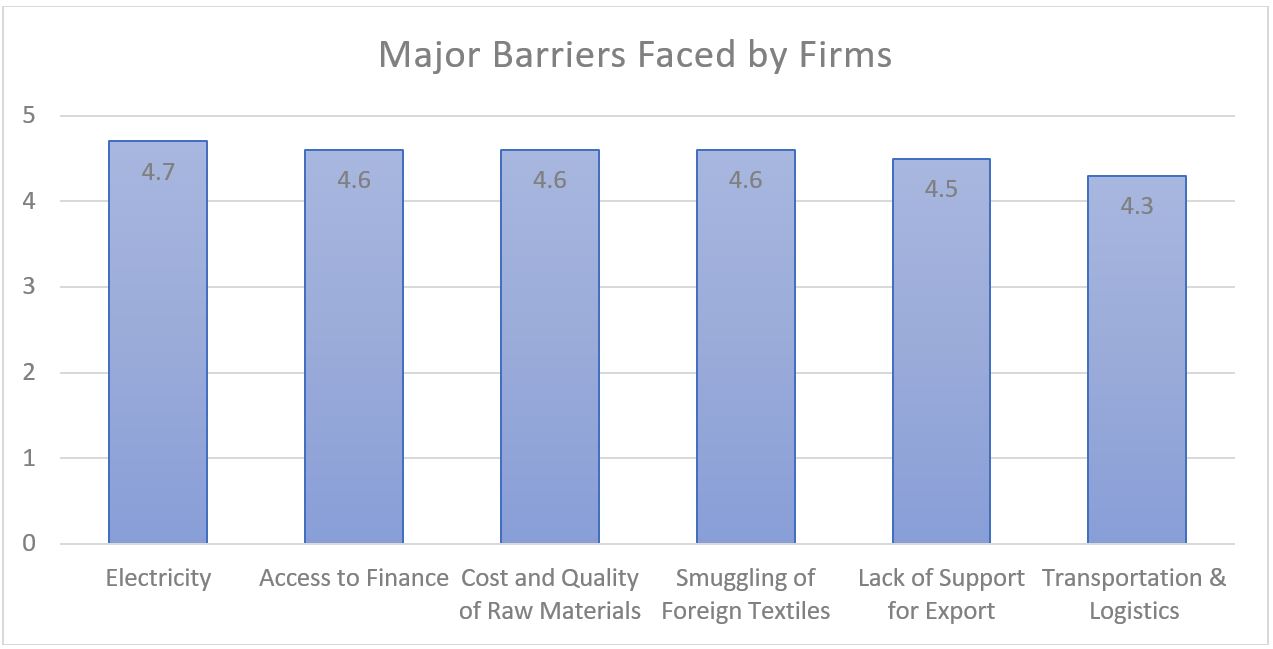
Figure 6: Major barriers faced by firms. Source: Author’s survey (Shehu, 2025).
A survey I conducted for my MPA thesis, covering 42 of the 105 textile and garment firms in the Manufacturers Association of Nigeria database, gives a closer view of what these firms face. Firms rated electricity, finance, raw materials, smuggling, export support, and transport and logistics as major constraints (Figure 6). The sample is small and the responses self-reported, so the findings are only indicative, but they show that firms across the chain face multiple constraints simultaneously. Nigeria's current programme increasingly recognises that reviving the sector requires a sequenced, integrated approach. But treating the chain as a single problem spreads support across stages whose constraints differ.
The ambition of building an integrated industry is understandable. It could generate linkages across agriculture, manufacturing and services. China, India and Turkey show what a deeply integrated textile and garment industry can become. But reaching that position involves a long and steep process of capability accumulation. Bangladesh and Vietnam built deeper capabilities progressively from garment production, while Ethiopia and Lesotho have found it harder to move beyond assembly.
For a sector whose previous production system has largely disappeared, the challenge is therefore not simply to provide support, but to determine a credible pathway from the capabilities Nigeria has today to the capabilities required for a competitive industry. The experience of other countries suggests that such a pathway may depend on links to global value chains as well as on the domestic market.
What Six Decades of Industrial Policy Reveal
Across the three cases, governments used broadly similar instruments: tariffs, finance, import restrictions and procurement. Read together, the cases suggest that Nigeria has mostly judged industrial policy at the point of investment, and learned least from what happened afterwards: which constraints remained, whether firms could manage them, and whether production reached scale. Five lessons stand out.
- The test of industrial policy is what happens after investment
Policy support, investment, sustained production, scale and deeper capability are distinct stages. Automotive shows the chain breaking after investment: installed capacity far above output, but no supplier base. Textiles shows it running in reverse, as the loss of firms eroded suppliers, technicians and production knowledge. Cement shows it becoming cumulative, until success itself produced a new constraint. The test of industrial policy is therefore not announcements or installed capacity, but whether utilisation rises, production is sustained, suppliers emerge, firms keep investing and learning, and markets remain contestable once scale is reached. Why did the chain hold in one case and break in two?
- Constraints are complementary and activity-specific
One answer is that constraints come in combinations. A tariff can protect producers, but it cannot provide reliable power, finance, logistics, skills or demand. This is consistent with recent evidence that Nigeria has leaned on protection while underinvesting in public inputs. The three cases add that even where instruments were applied, little was learned about why production did not follow.
Textile firms benefited from finance, tariffs and cotton development, yet still reported power, logistics, raw materials and finance as binding. Automotive attracted investment, but demand, vehicle finance and supplier development remained weak. Macroeconomic conditions formed part of this combination. Textiles contracted after the adjustment of the 1980s, when trade liberalisation and exchange-rate depreciation exposed producers to competition and raised input costs; despite continued support in the more favourable 2000s, it did not recover.
Cement, by contrast, expanded during those same 2000s, while automotive stalled in the 2016 recession as exchange-rate movements and foreign-exchange shortages made importing kits and offering vehicle finance more difficult. Stability alone therefore did not determine outcomes; it affected whether firms could use policy support, sustain demand and finance investment. The combination also differs by industry. Cement’s success was not unique to Nigeria, as Morocco shows, suggesting that its performance partly reflects the industry itself: standardised production, locally available raw materials and a structure that large, well-capitalised firms can integrate and manage.
- Firms, production structure and policy durability shape how constraints are navigated
A second answer lies in who faced the constraints. Cement producers had the capital and organisational capacity to build captive power, integrate supply chains and absorb long gestation periods. Textile firms and vehicle assemblers could not internalise constraints to the same degree. Policy durability mattered too. Cement’s protection was tied to investment commitments and lasted long enough for firms to reach scale, while the automotive levy was cut in 2020, before assemblers got there. Textile firms have received finance, procurement and protection since the 2000s, yet smuggling and other constraints have persisted. Innoson’s survival while many assemblers exited further suggests that firms can respond differently even within the same industry. Government support matters, but its effect depends on whether firms have the capability and incentive to convert it into production.
- Constraints change as industries develop
What constrains entry is not necessarily what constrains scale or upgrading, and success can create new constraints. Cement is the clearest case: once capacity exceeded demand, the policy challenge moved from supply to contestability, and the objective of policy should have shifted from building capacity to restoring competition. That shift has yet to happen. Moving beyond automotive assembly requires component suppliers, standards and engineering skills; a competitive textile industry increasingly depends on synthetic fibres and petrochemical inputs. The government therefore needs systematic feedback from production: which constraints firms face, whether interventions are changing them, and when the binding constraint has shifted.
- Evidence is aggregate and policy is federal, but production is local
The cases also expose a limitation in the evidence. Most figures are aggregates (installed capacity, market size, mills open), and even these vary across sources. They show whether an industry grew or shrank, but not which stage was constrained or what closed a plant. Cement is a partial exception because its few large producers are listed and file reports. Many instruments (tariffs, levies, tax incentives and finance) are also set federally, while production conditions are geographically specific. The textile survey illustrates what is gained by moving closer to the firm. Aggregate data show the sector’s decline, while firm-level evidence begins to reveal the constraints through which that decline is experienced. Nigeria’s more pressing challenge is not choosing instruments but understanding where and why production is constrained. Yet the information flows that would connect federal policy to the conditions firms face at state and local level remain weak.
Conclusion: Judging Policy by What Follows Investment
Macroeconomic stabilisation has created greater space for investment in the real economy, even as poverty and other structural constraints remain significant. The Nigeria Industrial Policy (NIP2025) was launched in February 2026, a new National Automotive Industry Development Plan runs from 2023 to 2033, and a new cotton, textile and garment transformation programme is being rolled out. Each represents a new response to problems Nigeria has faced before. The automotive plan now targets electric vehicles, even though the first plan did not bring conventional vehicle production to scale. The central question is whether, this time, these policies will draw sufficiently on what happened in earlier episodes, be sustained long enough for firms to reach scale, and remain attentive to the conditions under which firms actually produce and invest.
Nigeria has tried import substitution, liberalisation and, in the post-liberalisation era, a combination of both. The instruments used have mostly remained the same: tariffs, import restrictions, procurement and financial support, a pattern that runs across six decades of industrial policy. What the Nigerian government has not done consistently is learn from outcomes: whether firms reached scale, which constraints were relaxed, which persisted and which new ones emerged. The Nigeria Industrial Policy 2025 proposes a national monitoring system that could capture this learning, but its indicators have yet to be developed.
Nigeria is approaching another attempt at industrialisation, but the world is changing: automation and the fragmentation of supply chains due to geopolitics are reshaping production networks. The pathway through which countries raised productivity at an early stage, by moving from agriculture to labour-intensive manufacturing, may be narrowing as manufacturing becomes more skill- and capital-intensive, raising the productivity bar.
With less certainty about which pathway to follow, the first principle of the new industrial policy should be for Nigeria to look at its own record: the conditions of the country and how industrial policy has fared under them. Accounting for those conditions should therefore be at the heart of Nigeria's industrial ambition. It is what keeps that ambition realistic, not by lowering expectations, but by understanding what it will take to turn investment into sustained production and production into accumulated capability. Stabilisation has created the opening to do that. The next industrial policy should be judged not by what it announces, but by whether it learns what happens after investment arrives and changes course when production does not follow.
*Suleiman Ibrahim Shehu is an economic policy analyst working on industrial policy, firm competitiveness and investment in Nigeria
References
Agarwal, P., Abudu, D., Calabrese, L. and Chukwurah, O. (2023) The automotive sector in Nigeria: Opportunities under the AfCFTA. London: ODI.
Alade, B. (2025) 'National automotive policy in limbo, N136b investments stuck', The Guardian (Nigeria), 27 March.
Anudu, O. (2022) 'Nigeria loses 120 textile firms after pumping N500bn public funds', The Africa Report, 2 September.
Azeez, W. (2021) 'SPOTTED: 30% or 35% car import levy? Embarrassing error in the new finance law', TheCable, 16 February.
Central Bank of Nigeria (2019) Governor's address at meeting with service chiefs. Abuja: CBN.
Federal Ministry of Industry, Trade and Investment (2014) Nigerian Automotive Industry Development Plan. Abuja: FMITI.
Federal Ministry of Industry, Trade and Investment (2025a) National Cotton, Textile and Garment Industrial Transformation Programme (NCTG-ITP). Available at: https://nctg-itp.ng/ (Accessed: 7 October 2026).
Federal Ministry of Industry, Trade and Investment (2025b) Nigeria Industrial Policy 2025. Abuja: FMITI. Available at: https://nipc.gov.ng/assets/resources/nigeria-industrial-policy-2025/nigeria-industrial-policy-2025.pdf
International Energy Agency (2025) 'Nigerian Automotive Industry Development Plan (NADIP)', IEA Policies Database, updated 24 June.
Iyamah, F. (2026a) ‘Retooling Nigeria’s Industrial Policy to Deliver Real Economic Transformation’, Agora Policy, 17 April.
Iyamah, F. (2026b) ‘Market Power and Failure of Competition Policy in Nigeria’s Cement Industry’, Agora Policy, 3 February.
Maile, F. and Staritz, C. (2026) 'Lead firm strategies in the global textile and apparel industry: are disruptions reconfiguring the geographies of production?', Journal of Economic Geography, advance article. doi:10.1093/jeg/lbag016.
Muhammad, M., Mukhtar, M.I. and Lola, G.K. (2017) 'The impact of Chinese textile imperialism on Nigeria's textile industry and trade: 1960–2015', Review of African Political Economy, 44(154), pp. 673–682.
Odijie, M.E. (2024) 'Strategic industrial policy for sustainable development in Africa: the case of cement manufacturing', Africa Policy Research Institute, 6 August.
Oxford Business Group (2017) 'The fabric of society: textiles look to make a comeback thanks to an abundance of raw materials', in The Report: Nigeria 2017.
Paul, E. (2020) 'The state of Nigeria's automotive industry and its far-reaching effects', Techpoint Africa, 22 December.
PwC Nigeria (2016) Africa's Next Automotive Hub: One year after… Lagos: PricewaterhouseCoopers.
Rodrik, D. (2016) 'Premature deindustrialization', Journal of Economic Growth, 21(1), pp. 1–33. doi:10.1007/s10887-015-9122-3.
Salihu, H. (2025) 'Accounting for divergences in industrial policy performance in the cement and textile industries in Nigeria', The Journal of Development Studies, pp. 1–23. doi:10.1080/00220388.2025.2456904.
Shehu, S.I. (2025) From Decline to Growth: Revitalizing Nigeria's Textile Industry. MPA (National Development) thesis. Institute of South-South Cooperation and Development, Peking University.
The Guardian (Nigeria) (2026) 'Ending Nigeria's cement price crisis' [Editorial], 14 September.
United Nations Population Fund (2023) Country programme document for Nigeria (DP/FPA/CPD/NGA/9). New York: UNFPA.
Whitfield, L., Marslev, K. and Staritz, C. (2021) Can apparel export industries catalyse industrialisation? Combining GVC participation and localisation. SARChI Industrial Development Working Paper 2021-01. Johannesburg: University of Johannesburg.
Wolf, C. and Itaman, R. (2021) 'Industrial policy paved the way for Dangote's empire. Why it didn't deliver for all Nigerians', The Conversation.
World Bank (2024) Nigeria Development Update: Staying the Course: Progress Amid Pressing Challenges. Washington, DC: World Bank.
World Bank (2026) World Development Indicators: Manufacturing, value added (% of GDP) [NV.IND.MANF.ZS].