
By Ayobami Ayorinde | In the second quarter of 2026, Nigeria’s economy grew by 4.4%, the highest recorded since the second quarter of 2021, and an improvement on the 4.2% posted in the second quarter of 2025.
This is encouraging especially when compared to the sluggish growth of the past decade when the growth rate largely stalled below 3.5%. Still, the recent GDP growth remains a technical achievement that does not fully reflect the reality of many Nigerians. With the population growing by an estimated 2–3% annually, the economy is still growing at a pace that barely keeps up with demographic pressures. Nigeria, in many ways, is running as fast as it can only to stand still.
But what the country needs is not just to run faster; it is to ensure that GDP growth also translates to better jobs, increased productivity, reduced inequality and a better standard of living for most of its citizens. Recent reforms under President Bola Tinubu have brought some macroeconomic gains, particularly in GDP growth, government revenue and external reserves. However, these gains have come alongside increased poverty and a high cost of living for most individuals and households. The challenge is that GDP growth means little if poverty and inequality continue to widen.
According to the World Bank’s Poverty and Equity Brief[1], the share of Nigerians living in extreme poverty increased from 34.7% in 2018/19 to 41.8% in 2022/23, based on the international poverty line of $3.00 per person per day. This was before the effects of the reforms kicked in. In its Nigeria Development Update of April 2026, the World Bank recorded that Nigeria's poverty rate, using the national poverty line, increased from 56% in 2023 to 61% in 2024 and was estimated at 63% in 2025, meaning roughly 140 million Nigerians were living below the national poverty line in 2025[2]. Nigeria's Gini coefficient, which measures inequality, was estimated at 33.9 in 2022/23, down from 35.1 in 2018/19[3]. At face value, this suggests that inequality reduced and poorer households were catching up with richer households but instead, incomes fell across the distribution, with households at the top experiencing larger losses. Inequality narrowed partly because everyone became poorer and not because the poor became substantially better off.
Most of the projections from multilateral institutions and domestic financial organisations place Nigeria's 2026 GDP growth between 4.1% and 4.4%. While this would represent continued progress, it is unlikely to be transformative enough. For a country with a population growing by roughly 2–3% annually and millions of young people entering the labour market annually, growth at that pace may provide stability but is unlikely to substantially reduce underemployment or poverty.
The Tinubu administration has set an ambitious target of turning Nigeria into a $1 trillion economy by 2030. While the ambition is good, achieving this would require the economy to grow by at least 20% annually in dollar terms over the next four years, a pace of growth that even some of the fastest-growing economies such as China, Vietnam and Singapore have rarely achieved or sustained. So, while 2030 may not be a realistic target for the federal government to achieve a $1 trillion economy, the crux of the matter remains that Nigeria needs to build an economy capable of creating jobs, raising incomes, and delivering meaningful improvements in living standards at scale.
A Review of Nigeria’s Recent Economic Trajectory
Nigeria’s economic growth has been uneven over the last two decades. Between 2015 and 2025, Nigeria’s GDP recorded a Compound Annual Growth Rate (CAGR) of 2.4% and was weighed down significantly by the recessions of 2016 and 2020. In contrast, the CAGR of the decade prior (2004-2014) was 6.8%. The country’s long-run growth rate fell by 4.4% with the economy growing at only about one-third the pace of the preceding decade. The 2004–2014 period benefited from a combination of favourable global conditions and major domestic reforms. The decade that followed was however shaped by policy missteps and external shocks as seen in Fig 1 below.

A major advantage during the earlier period was the global oil market. Oil prices reached a high of almost $147 per barrel in July 2008 before falling during the global financial crisis. However, between 2009 and 2014, prices recovered and remained relatively stable within the $90–$110 per barrel range, supported by growing global demand and geopolitical developments. For an economy where oil accounted for the majority of export earnings, this was a major tailwind in terms of revenue and reserves. Domestic reforms during that period also strengthened investor confidence and supported growth. In the early- to mid-2000s, Nigeria secured debt relief from the Paris Club, liberalised the telecommunications sector, consolidated the banking industry and established the Excess Crude Account to save oil revenues above budget benchmarks and provide cushion for the economy during oil price downturns.
The story over the last eleven years, however, has been different. The first major setback came with the collapse in global oil prices in 2016. Given Nigeria's dependence on oil exports, government revenues declined sharply, foreign exchange earnings weakened, and investment slowed. The result was Nigeria's first economic recession since 1991. Policy responses by the government also compounded the challenge. Rather than allowing exchange rates to adjust more freely, the Central Bank of Nigeria (CBN) maintained a pegged exchange rate regime and introduced multiple exchange-rate windows which created distortions in the foreign exchange market, made access to foreign exchange difficult for businesses and investors, and discouraged capital inflows. The economy was hit again in 2020 by the COVID-19 pandemic. This time, global supply chains were disrupted, oil demand collapsed, and government finances came under severe strain, pushing the country into another recession.
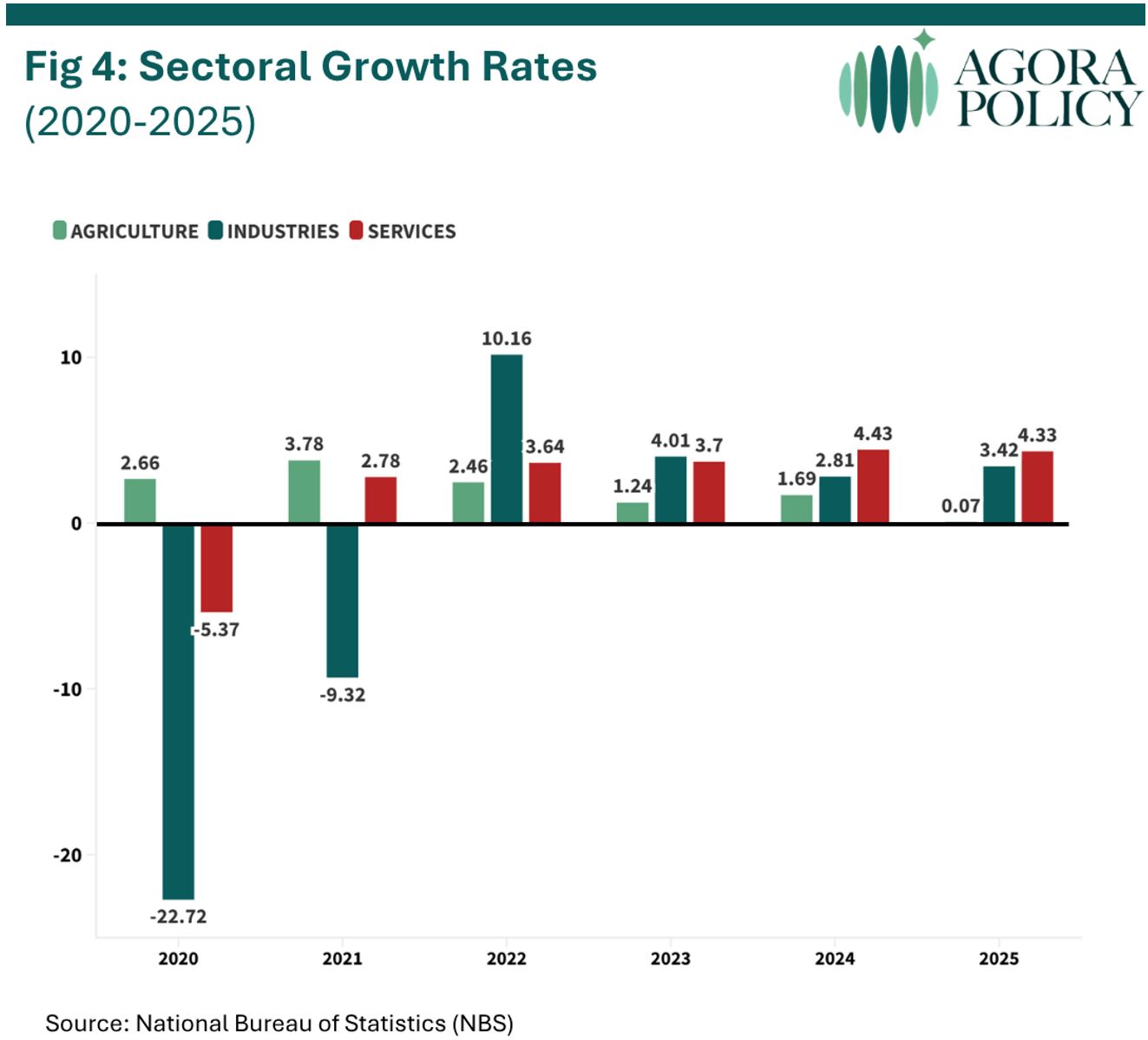
The experience of the past decade has exposed the risks of relying on commodity-led growth. Rising oil prices can temporarily increase revenues and improve reserves but the benefits are only concentrated in a small segment of the economy and do not readily translate to widespread job creation or sustained improvements in living standards. What Nigeria needs today is a different growth model that is driven by more productive economic activities at home and a more diverse export base. Since 2020, GDP growth has been positive but relatively weak as seen in Fig 2 below. The current administration has implemented important reforms, including the removal of petrol subsidies, exchange-rate unification, and tighter monetary policy. While these measures have come with substantial costs– higher inflation, weaker purchasing power and rising poverty levels– they have also addressed some of the structural distortions that constrained growth for years.

Sustained economic growth remains a non-negotiable starting point, but the current goal should not be GDP growth driven primarily by oil prices or high-end service sectors where the gains are easily concentrated among a few. Rather, it should be on improving human development that is reflected in an improvement in the productive capacity, welfare and living standards of all citizens.
The Need to Shift Growth Towards Labour-Absorbing Sectors
Currently, the non-oil sector drives about 96% of the country’s growth, anchored by services (finance, telecoms, insurance), which is at the moment the primary driver of Nigeria’s GDP. Although the service sector generates significant value, it can be capital-intensive and requires specialised skills. As a result, it is not well positioned to absorb the millions of low and middle-skilled young people entering the labour market each year.
Nigeria cannot pursue growth simply for growth’s sake. Achieving a high growth rate is only part of the solution but the quality and the composition of that growth matter just as much. For example, when capital-intensive sectors such as telecommunications, financial institutions, or oil and gas experience rapid expansion, they increase the country’s total GDP, but many of these sectors are relatively low in employment absorption. Despite their impressive contributions to output, they do not create jobs on a scale large enough to accommodate the many low and middle-skilled young Nigerians entering the labour market each year.
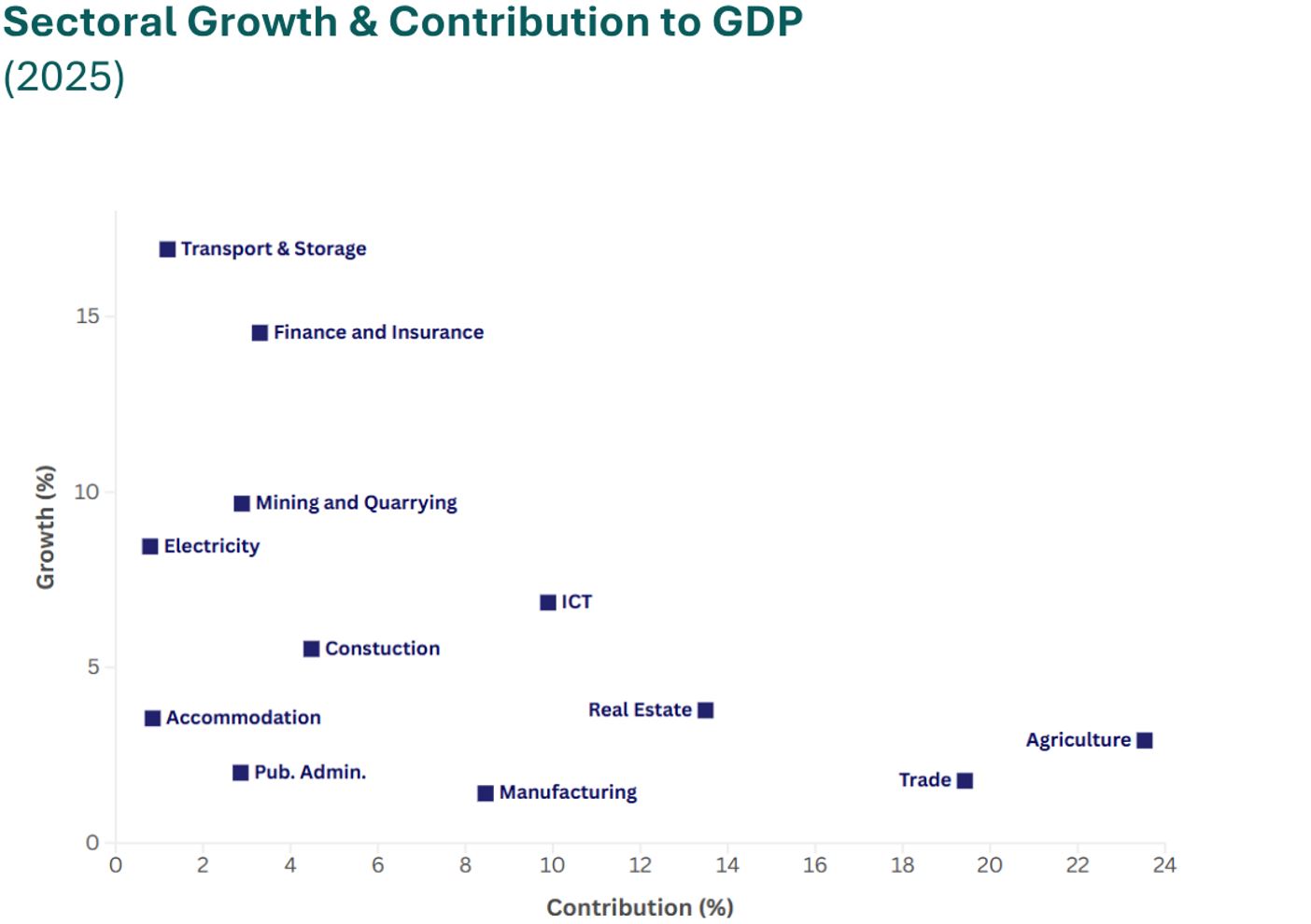
Fig. 3 below illustrates this reality. In 2025, sectors such as transport, finance, mining, and electricity recorded growth rates exceeding 7% but accounted for less than 4% of overall GDP together. Meanwhile, the sectors that make up a much larger share of the economy and employ more people like agriculture, trade and manufacturing, grew by less than 5%. Nigeria needs growth that is not only fast but also labour-absorbing. The focus should thus shift toward sectors where increased production naturally requires the hiring of large numbers of workers.
Sectors such as light manufacturing, garment and textile production, large-scale agro-processing, and infrastructure development offer this potential. Expanding these sectors would create demand for factory workers, operators, construction labourers, drivers, agricultural supervisors, logistics personnel, technicians, and other skilled and semi-skilled workers. Unlike highly capital-intensive industries where growth may not be felt much in employment numbers, growth in these sectors will have a direct and visible impact on job creation. This is not to suggest that the services sector is unimportant. On the contrary, services remains the largest contributor to Nigeria's GDP and the primary engine of economic growth. Sectors such as telecommunications, financial services, information technology, and trade have played a crucial role in sustaining economic activity, attracting investment, and driving innovation. However, for growth to become truly inclusive, it cannot be driven by services alone. Agriculture and industry must expand alongside the services sector.
No country has achieved large-scale job creation or sustained economic transformation without a strong industrial base. What the development stories from East Asia to more recent success stories such as Vietnam reveal is that industrialisation has been the bridge between agricultural economies and modern, high-income societies. For Nigeria, revitalising the manufacturing sector remains one of the most important pathways to achieving faster and more inclusive growth. Factories, agro-processing plants, construction projects, logistics networks, and industrial clusters create opportunities for workers at multiple skill levels while generating lasting economic value. They also produce stronger linkages across the economy, supporting small businesses, suppliers, transport operators, and service providers.
Despite its importance, manufacturing continues to account for a relatively modest share of Nigeria's economy. The sector recorded real growth of 3.24% in the second quarter of 2026, up from 1.13% in 2025 and 1.20% in 2024. While this remains below the level needed to transform the economy, it suggests that the sector still possesses significant untapped potential. The manufacturing sector has long struggled with structural constraints, including unreliable electricity supply, high energy costs, limited access to affordable credit, foreign exchange challenges, and inadequate transport infrastructure. These factors increase production costs and reduce the competitiveness of locally produced goods.
There are, however, some encouraging signs, and unlocking the potential in the sector will require establishing targeted industrial and manufacturing zones with reliable electricity, transport links, and streamlined regulations to significantly boost production in sectors such as textiles, food and beverage processing, pharmaceuticals, building materials, consumer goods, and light assembly industries.
Most importantly, Nigeria's industrial ambitions cannot be realised without addressing the country's power and energy deficit. Reliable electricity and adequate industrial gas supply remain fundamental requirements for a competitive manufacturing sector. When burdened with these challenges, firms will continue to rely on expensive self-generated power, limiting their ability to expand production, hire more workers and remain competitive. Recent investments, particularly in the refining segment, have the potential to reshape manufacturing’s contribution to economic growth. For example, the Dangote Refinery has contributed to strengthening domestic refining capacity, reducing dependence on imported petroleum products, and stimulating increased activity across the downstream petroleum value chain.
To further maximise the sector's contribution, Nigeria must continue investing in crude oil and natural gas infrastructure, strengthening security around pipelines and production facilities, reducing crude oil theft, and improving the overall investment climate for energy companies. Equally important is the expansion of gas infrastructure, given the growing role natural gas is expected to play in power generation, industrial development, and energy transition efforts.
Alongside manufacturing, agriculture remains one of Nigeria's most important tools for achieving broad-based economic growth. The sector grew by 4.39% in the second quarter of 2026, a remarkable improvement from the 2.82% recorded in the corresponding period of 2025. Agriculture also accounts for 26% of Nigeria's real GDP, making it one of the largest contributors to economic output. Beyond its contribution to GDP, the sector provides livelihoods, directly or indirectly, for between 30% and 60% of Nigerian workers.
Yet the greatest opportunity in agriculture does not lie simply in cultivating more crops but in improving productivity and value-addition. For example, sustained growth above 6-7% will be difficult to achieve if Nigeria’s yield per hectare continues to lag behind other major producing countries. The governments at the federal and state levels must also build integrated agricultural value chains that transform raw produce into finished and semi-finished products for domestic consumption and export.
Investments in storage facilities, cold-chain infrastructure, transportation networks, agro-processing industries, and market access can help reduce post-harvest losses, increase farmers’ incomes, and create employment opportunities beyond the farm gate. A key priority for state governments should be the establishment of Special Agro-Industrial Processing Zones (SAPZs) and agro-industrial hubs, already backed by the African Development Bank (AfDB), the International Fund for Agricultural Development (IFAD) and the Islamic Development Bank (IsDB)’s financing of $538 million[1]. Initiatives such as the Fasola Agribusiness Industrial Hub in Oyo State and the Ikun Dairy Farm in Ekiti State demonstrate how dedicated agricultural production and processing zones can attract private investment, improve productivity, reduce post-harvest losses, and create stable industrial employment.
Additionally, improving productivity will require stronger investments in agricultural research and development (R&D). Countries that have successfully transformed their agricultural sectors have done so by investing heavily in innovation, improved crop varieties, and modern farming techniques. To improve productivity and close this gap, the government must first enhance research and development, especially in developing, testing, and scaling high-yield and climate-resilient seedlings that match Nigeria’s soil and environmental conditions, modernising the way farming is done, and improving the value chain.
Lessons from Other Countries
History offers a useful lesson here because countries that achieved rapid economic transformation like China, Indonesia and Vietnam, did not rely solely on services-led growth. Their development was underpinned by strong agricultural productivity gains and the expansion of labour-intensive manufacturing, which created millions of jobs and raised household incomes. As workers became more productive and earned higher wages, demand for services also increased, creating a virtuous cycle of growth across the entire economy.
Around the 1990s, and early 2000s, Nigeria was neck-and-neck with, and even ahead of, countries like India, Bangladesh, and Vietnam in GDP per capita terms. However, while every other peer country's GDP per capita went up over the years as a result of industrialisation and global export, Nigeria’s GDP per capita fell to under $1,000, partly as a result of the Naira depreciation, as shown in Fig. 5 below.

Like Nigeria, Indonesia was a heavily oil-dependent economy prone to the "resource curse" in the 1970s/80s. However, Indonesia intentionally funnelled its oil windfalls directly into agricultural modernisation and rural infrastructure[1]. Later, it aggressively restricted the export of raw minerals like nickel, forcing global companies to build local processing factories. The result was a massive, labour-absorbent manufacturing ecosystem that successfully transitioned millions of rural farmers into stable factory jobs, steadily shrinking poverty rates.
Vietnam and China sustained high GDP growth for long periods while creating jobs in manufacturing, agriculture, and rapidly reducing poverty. Vietnam's economic rise began with the Đổi Mới reforms of 1986, which transformed the country from a centrally planned economy into a market-oriented one. The reforms encouraged private enterprise, opened the economy to foreign investment, liberalised trade, and improved conditions for businesses.
At the same time, agricultural reforms increased productivity and rural incomes, while the economy gradually shifted toward manufacturing and services[2]. The government attracted significant foreign direct investment by maintaining a stable business environment, investing in infrastructure, and promoting export-oriented industries such as textiles, electronics, and footwear. Vietnam also strengthened its transport networks, improved education and workforce skills, and integrated into global supply chains through trade agreements. In addition, the country further diversified its economy through tourism, the digital economy, and renewable energy[3]. These efforts helped Vietnam sustain average annual GDP growth of about 6–7% for over three decades, dramatically reduce poverty, expand exports, and emerge as one of Southeast Asia’s leading manufacturing hubs.
China’s economic transformation on the other hand started in 1978 when Deng Xiaoping launched the “Reform and Opening-Up” policy. Rather than implementing sudden economic liberalisation like Vietnam did, China adopted a gradual approach that allowed market mechanisms to develop while the government maintained control over key sectors such as energy, transportation, and heavy industry[4]. Agricultural reforms increased food production and rural incomes, while Special Economic Zones (SEZs), such as the one in Shenzhen, attracted foreign investment and became centres of export-oriented manufacturing.
China also aggressively attracted foreign direct investment by offering incentives to investors and creating a favourable business environment. Foreign companies brought capital, technology, and management expertise, helping China become a global manufacturing powerhouse. China also invested heavily in education, vocational training, and technological development. Rising university enrolment and workforce skills supported the country's move from low-cost manufacturing to higher-value industries such as electronics, artificial intelligence, semiconductors, electric vehicles, and renewable energy.
As a result, China sustained average annual GDP growth of more than 9% for several decades, lifted hundreds of millions of people out of poverty, became the world’s second-largest economy, and transformed itself from a largely agrarian society into a global manufacturing and technology hub. Its success was built on a blend of market reforms, strategic state intervention, infrastructure development, investment in human capital, export-led growth, and technological innovation.
|
Country |
Period of Rapid Growth |
Primary Growth Strategy |
Lesson for Nigeria |
|
China |
1978–2010s (following the Reform and Opening-Up policy) |
Gradual market reforms, Special Economic Zones (SEZs), export-led manufacturing, large-scale infrastructure investment, strategic state intervention, FDI attraction, human capital development, and technological upgrading |
Pursue a long-term industrial strategy that combines market reforms with strategic government support. Expand manufacturing through industrial clusters and SEZs, attract investment, invest heavily in infrastructure and skills, and gradually move into higher-value industries. |
|
Vietnam |
1986–present (following the Đổi Mới reforms) |
Market-oriented reforms, agricultural productivity improvements, export-oriented manufacturing, FDI attraction, trade integration, infrastructure investment, and workforce development |
Improve the business environment, strengthen agriculture as a foundation for industrialisation, promote export-oriented manufacturing, integrate into global value chains, and invest consistently in infrastructure and human capital. |
|
Indonesia |
1970s–2000s |
Agricultural modernisation funded by oil revenues, rural infrastructure, downstream processing of natural resources, and manufacturing expansion |
Use natural resource revenues to finance productive investments rather than consumption. Invest in agriculture, rural infrastructure, and local value addition to create manufacturing jobs and reduce dependence on raw commodity exports. |
Policy Recommendations
Macroeconomic stability should remain the foundation of Nigeria's growth strategy. Sustainable economic development cannot occur in an environment characterised by low growth and macro-economic uncertainty. But while macro-economic stability and GDP growth are necessary for any measure of progress, they are not sufficient conditions if the goal is improved welfare for citizens across the board. Nigeria thus needs a growth-plus strategy and should be deliberate about the following:
- Prioritise Job-Creating Growth: While the economy is gradually returning to a growth path following recent reforms, the benefits are yet to translate into widespread improvement in living standards. Poverty, unemployment, and inequality remain high or have even increased because the reported growth is not generating quality employment opportunities at the required level. Going forward, the government should provide fiscal, monetary and trade incentives to sectors capable of creating jobs at scale, particularly light manufacturing, agro-processing, construction, and other labour-intensive industries. Some of these sectors have relatively lower barriers to entry and are better positioned to absorb Nigeria's rapidly growing labour force. A growth strategy that creates quality employment at the desired scale will not only reduce poverty but also expand domestic demand and make economic growth more inclusive.
- Increase Investment in Human Capital: Nigeria cannot achieve faster and sustained economic growth without a better educated, healthier and more productive workforce. The government should place more emphasis on basic and technical education and training, while also strengthening technical colleges across the country, particularly in areas that support manufacturing, construction, agriculture, energy and other productive sectors. As Nigeria seeks to industrialise, manufacturers will need many skilled workers that cannot be filled by only those with academic degrees. When the country’s human capital is built and invested in, it increases how much each worker can produce, earn and contribute to the economy. As such, the goal is to move from simply producing graduates to producing more employable and productive workers
- Fix the Power Sector and Improve Stock of Other Critical Infrastructure: Reliable electricity remains indispensable for Nigeria's industrial development and competitiveness. The country cannot realistically industrialise when businesses still have to spend a large part of their income generating their own electricity. The government thus needs to make improving the power sector a central part of its industrialisation strategy by addressing the problems across the electricity value chain from gas supply and power generation to transmission and distribution. The government also needs to continue to expand the country’s stock of other critical infrastructure needed to boost national productivity and competitiveness and make the country more attractive to foreign direct investments.
- Earmark Savings from Reforms to Expand Productive Capacity: Following the increase in federation revenue from fiscal and monetary reforms, the government needs to be more deliberate about ensuring that the money freed up is used to strengthen the productive capacity of the economy. The government should channel more of these resources into sectors that can expand production, create jobs and support long-term economic growth, particularly agriculture, education and skills development, manufacturing and investments in critical infrastructure that would help Nigerians and businesses produce more, become more competitive and earn better incomes.
- Make Food Security a Central Part of Nigeria's Growth Strategy: The availability and affordability of food directly affect productivity across the entire economy. When food inflation bites and prices keep rising, households have less discretionary income for other necessities and workers need higher wages to maintain the same standard of living. Producing more food is only a part of increasing productivity but overall productivity is stalled if farmers cannot get their produce to markets on time, or if a large part of what they produce is lost before it reaches consumers. The government must therefore address food insecurity by improving national security, raising agricultural productivity through more investments in research and development and extension services, enhancing rural infrastructure, and strengthening agricultural value chains. This includes improving access to inputs, irrigation, storage, rural roads, transportation, processing and markets. Poor roads and high transport costs make food significantly more expensive by the time it reaches consumers. Investments in rural roads, logistics networks and rail where commercially viable can help reduce what consumers pay for food. The government should also make cold-chain infrastructure a major priority, particularly for perishable products. Better cold storage and transportation would reduce post-harvest losses, extend the shelf life of food and allow farmers to reach markets farther from where they produce.
- Enhance Social Protection to Reduce Poverty and Inequality: Economic growth is important for reducing poverty, but growth alone does not guarantee that poor households will benefit or that income inequality will not expand. This is why the government needs to be more deliberate about making sure that economic growth actually improves the lives of the poor and those at the bottom of the income ladder. The government needs to take social protection more seriously and be more proactive in providing needed support to the vulnerable.
Conclusion
Nigeria's recent GDP growth figures give reasons for optimism. But they also show that the pace and structure of that growth are still insufficient to meet the aspirations of a rapidly growing population and an economy that hopes to serve its people better. While recent reforms have helped stabilise the economy and correct some long-standing distortions, stabilisation is only the first step. The next challenge is achieving sustained, broad-based, and inclusive growth. To do so, Nigeria must focus on sectors and investments capable of generating both output and employment at scale. Manufacturing, infrastructure, agro-processing and value-addition to mineral resources all have important roles to play.
The objective should not be to choose one sector over another, but to build an economy where each sector reinforces the others. The experiences of countries such as China, Indonesia and Vietnam also demonstrate that transformative growth is often the result of consistent policy direction, strategic investments, export competitiveness, industrialisation, and a relentless focus on productivity. Nigeria may not replicate their exact paths, but the underlying lesson remains that economies across the world grow rapidly when governments consistently create an environment that enables businesses to invest, produce, employ, and compete globally.
Ultimately, Nigeria's economic challenge is not merely to grow faster, but to grow inclusively. Growth must become more labour-absorbing, more productive, and more inclusive. A growth rate of 3–4% may help maintain macroeconomic stability, but it is unlikely to significantly reduce poverty or absorb the number of young people entering the labour market each year. The country needs sustained growth well above population growth and, ideally, above 6-7% annually over the medium term. Such high growth must be for a sustained period and must be complemented with deliberate measures that ensure that benefits of growth are felt by all strata of society.
The real measure of success in terms of human development is not whether GDP grows by a few percentage points in any given year or across a few years. It will be whether economic growth translates into productive and high-paying jobs at scale, stronger businesses, higher household incomes, lower poverty and inequality, and a tangible improvement in the quality of life of ordinary Nigerians. That is the growth Nigeria ultimately needs and the development it must strive to achieve
[1] https://documents1.worldbank.org/curated/en/099253204222517873/pdf/IDU-3e010784-3371-4dcb-b923-112e98052ed9.pdf
[2] https://documents1.worldbank.org/curated/en/099040726024529229/pdf/P513192-aac8242c-b971-4654-bb1c-009497fba827.pdf
[3] https://documents1.worldbank.org/curated/en/099253204222517873/txt/IDU-3e010784-3371-4dcb-b923-112e98052ed9.txt
[4] https://www.afdb.org/en/news-and-events/press-releases/nigeria-african-development-bank-and-partners-agree-fast-track-implementation-special-agro-industrial-processing-zones-program-74779
[5] https://www.rba.gov.au/publications/bulletin/2011/dec/4.html
[6] https://irpj.euclid.int/articles/vietnams-economic-transformation-successes-challenges-and-strategies-for-sustainable-growth/
[7] https://www.vietnam-briefing.com/news/why-is-vietnams-economy-growing-so-fast.html/
[8] https://www.weforum.org/stories/2025/06/how-china-got-rich-40-year-history-of-economic-transformation/