
By Aisha Suleiman | Nigeria's growing energy demand, persistent electricity shortages, and continued dependence on fossil fuels present significant challenges to economic growth, energy security, and climate resilience.
At the same time, the global transition towards low-carbon energy systems is creating new opportunities for countries to participate in emerging clean energy value chains. Green hydrogen, produced using renewable electricity, has emerged as a promising solution for decarbonising hard-to-abate sectors while supporting industrial development, energy diversification, and long-term economic growth.
Green hydrogen offers Nigeria a strategic opportunity to shape a resilient energy future, fostering industrial growth and inspiring confidence in sustainable development. The ongoing development of the National Hydrogen Policy reflects growing national recognition of hydrogen's potential role in achieving these objectives.
However, realising this opportunity will require more than policy ambition, as success will depend on effective implementation of the National Hydrogen Policy, sustained investment in renewable energy and hydrogen infrastructure, supportive regulatory frameworks, targeted financing mechanisms, workforce development, and strong collaboration between government, industry, academia, and international partners.
This paper examines the role of green hydrogen in Nigeria's energy future by assessing the country's opportunities and constraints, drawing lessons from emerging hydrogen economies, and proposing practical policy recommendations to accelerate implementation and support the development of a competitive and sustainable green hydrogen industry.
Nigeria’s Energy Challenges and the Green Hydrogen Opportunity
Despite being one of Africa's largest economies, Nigeria continues to face profound energy challenges that constrain its economic and social development. The country has one of the world's largest electricity access deficits, with more than 85 million people lacking access to reliable electricity[i]. Even for those connected to the grid, electricity supply remains highly unreliable due to persistent grid instability. Nigeria's national power grid has experienced over 200 system collapses since its inception, including at least 10 major collapses in 2024 alone[ii]. These recurring outages impose high economic costs, with the World Bank estimating annual losses of between $25 billion and $29 billion (approximately 5–7% of GDP) due to inadequate and unreliable electricity supply.[iii] The resulting disruptions to industrial productivity, business operations, and investor confidence continue to hinder the country's broader socio-economic development.
Globally, energy systems are undergoing significant transformation, driven by the dual priorities of enhancing energy security and reducing greenhouse gas emissions. While the energy crisis triggered by the conflict in Ukraine prompted some countries to increase fossil fuel production and diversify energy supplies temporarily, it also accelerated investments in renewable energy, energy efficiency, and clean energy technologies, particularly across the European Union. More recently, shifts in U.S. energy policy have placed greater emphasis on domestic fossil fuel production, illustrating that national energy strategies continue to balance economic, geopolitical, and climate considerations[iv]. Nevertheless, the long-term global trend remains one of expanding renewable energy deployment and advancing low-carbon technologies in line with the objectives of the Paris Agreement to limit the rise in global average temperatures. Against this backdrop, Nigeria's continued dependence on fossil fuels shows the importance of developing a diversified and resilient energy system that leverages its abundant renewable energy resources while supporting sustainable economic growth.
In November 2021, during COP26 in Glasgow, late President Muhammadu Buhari announced Nigeria's commitment to achieving net-zero emissions by 2060. Subsequently, on 24 August 2022, then Vice President Yemi Osinbajo launched the Energy Transition Plan (ETP), outlining the nation's strategy to reach this ambitious target. The ETP aims to address climate change while meeting the country's energy needs, focusing on lifting 100 million people out of poverty, driving economic growth, and providing modern energy services to the entire population.[v]
On 21 February 2025, Nigeria took a significant step toward advancing its clean energy transition with the launch of the development of its National Hydrogen Policy[vi]. The initiative signalled the government's intention to integrate hydrogen into the country's long-term energy strategy and laid the foundation for a coordinated policy framework to support the development of a green hydrogen economy.
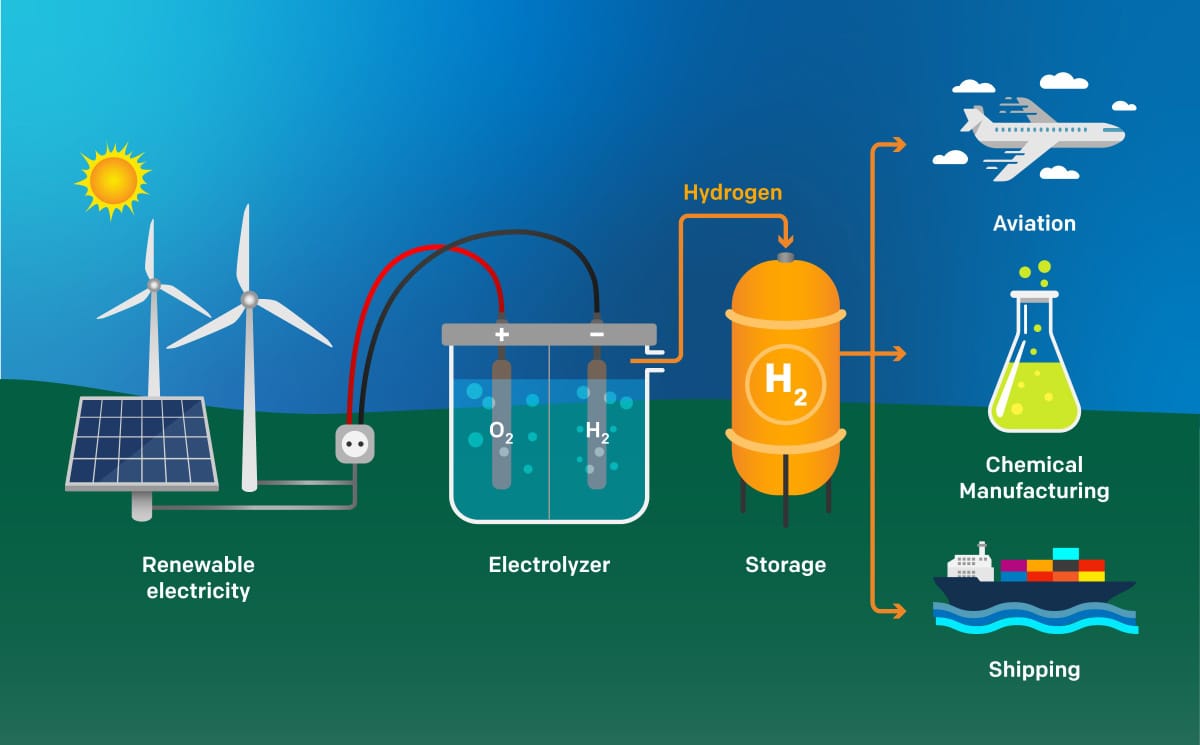
Green hydrogen(H₂) is produced by splitting water into hydrogen and oxygen through electrolysis powered by renewable electricity, such as solar, wind, or hydropower. Unlike conventional hydrogen produced from fossil fuels, green hydrogen generates little to no greenhouse gas emissions during production.
As an energy carrier rather than a primary energy source, it can store renewable energy for later use and serve as a clean fuel or industrial feedstock. Green hydrogen is particularly valuable for decarbonising sectors that are difficult to electrify directly, including steel production, fertilizer manufacturing, petroleum refining, chemical industries, heavy-duty transport, shipping, aviation, and long-duration energy storage.
The global hydrogen market was valued at approximately $229.5 billion in 2025 and is projected to reach $406.9 billion by 2034[vii], growing at a compound annual growth rate (CAGR) of about 6.7%, while the green hydrogen market alone is projected to grow from about $13 billion in 2025 to more than $337 billion by 2035 with a CAGR of nearly 39%.[viii]
For Nigeria, green hydrogen presents an opportunity to leverage the country's abundant solar resources, existing natural gas infrastructure, industrial base, and strategic export position to diversify its economy beyond oil and key into the green hydrogen market[ix].
Green hydrogen could help decarbonise fertilizer production by replacing natural gas-derived hydrogen with renewable hydrogen, reducing emissions from ammonia and urea manufacturing. It could also lower emissions in petroleum refineries by supplying clean hydrogen for refining processes such as hydrocracking and desulfurization.
In the transport sector, green hydrogen could power heavy-duty trucks traveling long distances, such as freight vehicles moving goods from the South West to the North West, North East, or South East, where long driving ranges and fast refuelling make hydrogen a promising alternative to battery-electric vehicles. However, this would require the development of a nationwide hydrogen refuelling network along major freight corridors to ensure reliable access to fuel.
The proposed revival of the Ajaokuta Steel Company[x], currently under negotiation by the Federal Government, presents another potential opportunity to incorporate low-carbon steel production technologies when the plant becomes operational, as green hydrogen has the greatest potential to reduce emissions in iron ore reduction, which is the most carbon-intensive stage of steel production. Unlike conventional methods that use carbon monoxide and emit CO₂, hydrogen-based direct reduction (H₂-DRI) produces water, making it a cleaner pathway for low-carbon steel. However, the conventional process remains more commercially established.[xi]
Although green hydrogen is not yet part of Nigeria's commercial energy mix, the country has laid the foundation for its development through the draft National Hydrogen Policy[xii], international partnerships, and emerging pilot and commercial initiatives. These include the Nigeria Clean Hydrogen Project, launched by the United Nations Industrial Development Organization (UNIDO) with funding from the Global Environment Facility (GEF) to strengthen the country's clean hydrogen ecosystem,[xiii] and the proposed $7.6 billion LONGi–APPL green hydrogen and green methanol project in Akwa Ibom State, which signals growing private sector interest in large-scale green hydrogen production[xiv]. Together, these initiatives demonstrate Nigeria's commitment to building a competitive green hydrogen industry.

Potential areas for Green Hydrogen production in Nigeria
(Source: GIZ Local Green Hydrogen offtake study for Nigeria by H2Uppp, 23 April 2024)
Lessons for Nigeria from What Other Countries Are Doing on Green Hydrogen
-
Namibia: Leveraging Renewable Resources for Green Hydrogen Exports
Namibia has positioned itself as one of Africa's leading green hydrogen producers by capitalising on its world-class solar and wind resources. Its flagship Hyphen Hydrogen Energy Project, valued at approximately $10 billion, is expected to produce around 2 million tonnes of green ammonia annually for export, primarily to Europe. [xv] The project is projected to create thousands of direct and indirect jobs while contributing significantly to Namibia's long-term economic growth and export diversification. The government has also established a dedicated Green Hydrogen Programme to coordinate policy, investment, and infrastructure development.
Lesson for Nigeria: Namibia demonstrates that countries with abundant renewable resources can attract large-scale private investment and develop green hydrogen as a new export industry through strong government coordination and long-term policy commitment. -
South Africa: Using Green Hydrogen to Decarbonise Industry
South Africa is integrating green hydrogen into its industrial development strategy through the Hydrogen Society Roadmap[xvi], focusing on steel production, chemicals, mining, heavy-duty transport, and green ammonia. Supported by international climate finance under the Just Energy Transition Partnership (JETP), South Africa is developing hydrogen value chains that build on its competitive advantage in platinum group metals used in fuel cells. Although many commercial projects are still under development, the country has established one of Africa's most comprehensive hydrogen innovation ecosystems.
Lesson for Nigeria: Green hydrogen should support domestic industrialisation and value addition alongside exports, particularly in sectors such as fertilizer production, refining, steel manufacturing, and heavy transport. -
Egypt: Attracting Investment through Industrial Hubs
Egypt has rapidly emerged as one of Africa's leading destinations for green hydrogen investment. Through the Suez Canal Economic Zone (SCZone), the country has signed more than 20 agreements and MoUs with international developers to establish green hydrogen and green ammonia production facilities. Egypt has introduced investment incentives, streamlined regulations, and leveraged its strategic location to position itself as a future supplier of clean fuels to Europe and Asia.[xvii]
Lesson for Nigeria: Developing dedicated hydrogen industrial zones, providing clear investment incentives, and utilising strategic port infrastructure can significantly improve investor confidence and accelerate project development. -
Morocco: Building Export Corridors to Europe
Morocco has adopted an ambitious national hydrogen strategy that combines abundant renewable energy resources with proximity to European markets. In 2024, the government launched the "Morocco Offer", providing land access, infrastructure support, and investment incentives for green hydrogen developers[xviii]. Morocco is also strengthening its electricity interconnections with Europe and positioning itself as a future exporter of green hydrogen and green ammonia.
Lesson for Nigeria: Competitive renewable resources alone are insufficient; governments must also invest in enabling infrastructure, export logistics, and international partnerships to access global hydrogen markets. -
Germany: Creating Demand through Policy and International Partnerships
Germany has become one of the world's largest future hydrogen markets through strong policy support and international cooperation. Under its updated National Hydrogen Strategy, Germany estimates it will require approximately 95–130 TWh of hydrogen annually by 2030, with 50–70% expected to be imported due to limited domestic renewable energy resources. Germany has therefore established partnerships with several African countries to secure future hydrogen imports while investing heavily in domestic hydrogen infrastructure.
Lesson for Nigeria: Developing long-term export markets requires early engagement with importing countries, harmonised sustainability standards, and reliable supply chains supported by strong bilateral partnerships.
Policy Recommendations
The development of Nigeria's draft National Hydrogen Policy is an important milestone in the country's energy transition. However, successful implementation will depend on effective institutional coordination, sustained investment, supportive regulation, and clear implementation mechanisms. As the draft policy progresses towards formal approval, the following recommendations outline priority actions required to establish a competitive and sustainable green hydrogen economy.
- Prioritise the Implementation of the National Hydrogen Policy: The successful development of Nigeria's hydrogen economy will depend on the effective implementation of the recently developed National Hydrogen Policy. The Federal Government should develop a detailed implementation roadmap that clearly defines institutional responsibilities, implementation timelines, financing mechanisms, and measurable performance indicators. A dedicated inter-ministerial coordination committee comprising the federal ministries of Power, Petroleum Resources, Environment, Industry, Trade and Investment, Science and Technology, Water Resources, and Finance should oversee implementation and ensure alignment across sectors. Regular monitoring and annual progress reports should be published to promote transparency, accountability, and investor confidence.
- Accelerate Investment in Hydrogen Infrastructure: Infrastructure remains one of the most significant barriers to the commercialisation of green hydrogen in Nigeria. Government should prioritise investments in renewable energy generation, electrolysers, hydrogen storage facilities, transportation networks, and export infrastructure. Existing industrial clusters and special economic zones, particularly in coastal states with access to ports, should be developed into hydrogen production hubs that serve both domestic industries and export markets. Expanding renewable electricity generation is also important, as the economic viability of green hydrogen depends on access to affordable and reliable renewable power.
- Stimulate Domestic Demand for Green Hydrogen: While exports present significant economic opportunities, Nigeria should also develop domestic markets for green hydrogen to reduce investment risks and strengthen industrial competitiveness. The government should introduce targeted incentives to encourage the adoption of green hydrogen in sectors that are difficult to decarbonise, including fertiliser production, petroleum refining, steel manufacturing, heavy-duty transportation, and shipping. Pilot programmes demonstrating hydrogen use in these sectors would provide valuable operational experience while encouraging private sector participation and reducing dependence on fossil fuels.
- Strengthen Investment Incentives and Mobilise Green Finance: Given the high capital costs associated with green hydrogen projects, Nigeria should establish an enabling investment environment capable of attracting both domestic and international investors. This should include fiscal incentives such as temporary corporate tax exemptions for qualifying green hydrogen projects (tax holidays), import duty exemptions for hydrogen equipment, accelerated capital allowances, and access to concessional financing through institutions such as the Bank of Industry and the Development Bank of Nigeria. Government should also leverage international climate finance, multilateral development banks, green bonds, and blended finance mechanisms to reduce investment risks. Public-private partnerships should be encouraged to mobilise private capital while sharing project risks and technical expertise.
- Invest in Research, Innovation and Human Capital Development: The growth of Nigeria's hydrogen economy will require a skilled workforce and strong domestic research capacity. Government should invest in hydrogen research through universities, research institutes, and centres of excellence while supporting collaboration between academia and industry. Technical and vocational institutions should introduce specialised training programmes on hydrogen production, storage, transportation, safety, and equipment maintenance. Building local technical expertise will reduce dependence on foreign knowledge, promote technology transfer, create high-quality employment opportunities, and strengthen Nigeria's long-term competitiveness in the global hydrogen market.
- Strengthen International Partnerships and Develop Export Markets: Nigeria should actively pursue strategic international partnerships to support technology transfer, investment, capacity building, and market access. Bilateral cooperation with prospective hydrogen importing countries, particularly Germany, the Netherlands, Japan, South Korea, and others, can facilitate long-term offtake agreements and improve investor confidence. Participation in international hydrogen certification schemes and sustainability standards will also be essential for ensuring Nigerian hydrogen products meet global market requirements and remain competitive in emerging export markets.
- Promote Pilot Projects and Demonstration Plants: Before scaling up commercial hydrogen production, Nigeria should support pilot projects that demonstrate the technical and economic feasibility of hydrogen technologies under local conditions. Demonstration projects in industrial facilities, transportation, power generation, and energy storage will generate valuable operational data, reduce investment uncertainty, and build technical capacity. Lessons from countries such as Ghana illustrate that early-stage pilot projects play a critical role in developing local expertise, validating technologies, and attracting larger commercial investments.
- Establish a Robust Regulatory and Standards Framework: As hydrogen projects begin to emerge, Nigeria should strengthen its regulatory framework to ensure safe production, transportation, storage, and utilisation of hydrogen. Relevant regulatory agencies, including the Standards Organisation of Nigeria (SON), the Nigerian Midstream and Downstream Petroleum Regulatory Authority (NMDPRA), and the Nigerian Electricity Regulatory Commission (NERC), should develop comprehensive technical standards, certification systems, environmental safeguards, and safety regulations aligned with international best practices. Clear regulatory requirements will reduce investor uncertainty, improve public confidence, and position Nigeria to participate effectively in international hydrogen trade.
Conclusion
Nigeria stands at an important moment in its energy transition. While the country's National Hydrogen Policy provides an important foundation, its success will ultimately depend on effective implementation. Building a competitive green hydrogen industry will require sustained investment in renewable energy and hydrogen infrastructure, a supportive regulatory environment, skilled human capital, strong institutional coordination, and meaningful collaboration between government, industry, academia, and development partners.
Green hydrogen should therefore be viewed not as a replacement for Nigeria's broader energy transition, but as a strategic complement capable of accelerating decarbonisation in hard-to-abate sectors while creating new opportunities for economic diversification and regional leadership. By prioritising implementation, fostering innovation, mobilising investment, and strengthening international partnerships, Nigeria can move beyond its traditional role as a fossil fuel producer and establish itself as a competitive participant in the emerging global clean hydrogen economy.
The decisions made over the coming decade will determine whether Nigeria merely observes the global hydrogen transition or helps shape it. Acting decisively today will position the country to capture the economic, industrial, and environmental benefits of one of the most significant energy transformations of the twenty-first century.
- Aisha Suleiman, a fellow of the first cohort of the Agora Policy Writing Fellowship, is a climate change enthusiast.
Cover Image Source: Earth Justice
Endnotes
[i] World Bank. (2021, February 5). Nigeria to improve electricity access and services to citizens. https://www.worldbank.org/en/news/press-release/2021/02/05/nigeria-to-improve-electricity-access-and-services-to-citizens
[ii] Shibayan, D. (2024, November 7). Nigeria's major cities suffer blackouts as the power grid collapses yet again. Associated Press. https://apnews.com/article/nigeria-nationwide-power-outage-electricity
[iii] World Bank. (2023). Technical Note 2: Igniting economic growth by reforming Nigeria's power sector (Report No. 182935). World Bank. https://documents.worldbank.org/en/publication/documents-reports/documentdetail/099061723133022449
[iv] Reuters. (2025, February 4). U.S. Interior Department takes first steps to carry out Trump energy agenda. https://www.reuters.com/world/us/us-interior-department-unveils-orders-carry-out-trump-energy-agenda-2025-02-04/
[v] Federal Government of Nigeria. (2022). Nigeria Energy Transition Plan. https://www.energytransition.gov.ng (Accessed: 20 July 2026)
[vi] H2-diplo (2025) Nigeria launches national hydrogen policy development to advance clean energy future. Available at: https://h2diplo.de/news/nigeria-launches-national-hydrogen-policy-development-to-advance-clean-energy-future/ (Accessed: 25 July 2026)
[vii] Fortune Business Insights, 2026. Hydrogen market size, share & industry analysis by type, 2026–2034. Available at: https://www.fortunebusinessinsights.com/hydrogen-market-114275 (Accessed: 16 July 2026)
[viii] Precedence Research, 2026. Green hydrogen market size to reach USD 337.37 billion by 2035. GlobeNewswire, 24 April. Available at: https://www.globenewswire.com/news-release/2026/04/24/3280727/0/en/green-hydrogen-market-size-to-reach-usd-337-37-billion-by-2035.html (Accessed: 16 July 2026).
[ix] Ebii, C. (2023) Green hydrogen in Nigeria: Potentials and pitfalls. Heinrich Böll Stiftung Abuja Office – Nigeria. Available at: Heinrich Böll Stiftung Abuja Office – Nigeria (Accessed: 25 July 2026).
[x] Olisah, C. (2026) Ajaokuta steel revival deal with Chinese firm due before end of 2026 – FG. Nairametrics, 8 July. Available at: Nairametrics (Accessed: 25 July 2026).
[xi] Kohitlhetse, I.; Chiririwa, H. Emerging Trends and Opportunities in Hydrogen-Based Direct Reduction for Sustainable Low-Carbon-Emission Steelmaking. Processes 2026, 14, 1529. https://doi.org/10.3390/pr14101529
[xii] THISDAY. (2026, July 15). FG bets on hydrogen economy to drive post-oil devt, aims jobs, net-zero by 2060. https://www.thisdaylive.com/2026/07/15/fg-bets-on-hydrogen-economy-to-drive-post-oil-devt-aims-jobs-net-zero-by-2060/
[xiii] United Nations Industrial Development Organization. (2026, June 3). The launch of the Nigeria Clean Hydrogen Project, funded by GEF. UNIDO Green Hydrogen. https://hydrogen.unido.org/news/launch-nigeria-clean-hydrogen-project-funded-gef
[xiv] Hydrogen Insight. (2025, February 26). LONGi signs preliminary €7.6bn deal with local developer to build massive green hydrogen project in Nigeria. https://www.hydrogeninsight.com/production/longi-signs-preliminary-7-6bn-deal-with-local-developer-to-build-massive-green-hydrogen-project-in-nigeria/2-1-1784351
[xv] Hyphen Hydrogen Energy. (2025). The Hyphen project. https://hyphenafrica.com/the-hyphen-project/
[xvi] Green Hydrogen Organisation (GH2). (n.d.). South Africa. Available at: https://gh2.org/countries/south-africa
[xvii] Suez Canal Economic Zone (SCZone). (2025). Green Hydrogen Projects. https://sczone.eg
[xviii] Ministry of Investment, Convergence and Evaluation of Public Policies (MICEPP). (2024, August 29). Green Hydrogen: Meeting of the Steering Committee for the Morocco Offer. Available at: https://micepp.gov.ma/en/le-ministere/actualites/green-hydrogen-meeting-steering-committee-morocco-offer